How industrial air frying works
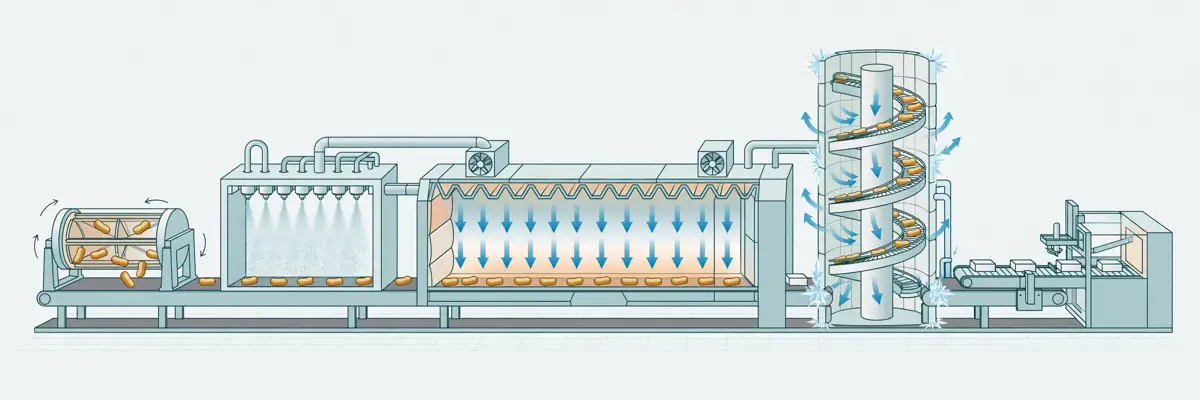
In October 2026, JBT Marel announced an industrial air frying solution aimed at the coated and battered product market — breaded chicken, fish portions, vegetable patties, and similar items. The announcement is worth understanding because it shows exactly what "air frying" means at industrial scale: not a countertop appliance scaled up, but a multi-stage continuous line.
According to JBT Marel's announcement, the line runs five stages in sequence:
- Coating — products are battered and breaded, building the crust structure that will carry flavor and texture.
- Controlled oil application — instead of a fryer bath, a measured amount of oil is applied to the coated product. According to JBT Marel, this controlled application is the mechanism behind their claimed reduction in fat.
- High-airflow impingement cooking — high-velocity hot air jets cook the product through, setting the coating and developing crispness.
- Spiral freezing — cooked products move directly into a spiral freezer, holding quality before distribution.
- Integrated packaging — frozen products are packed in-line, completing the cook-to-pack flow.
A few of the vendor's performance claims deserve careful reading. JBT Marel states that the line eliminates pre-frying entirely — the oil bath is replaced by the coating and oil-application stages. JBT Marel also claims up to 50%+ reduction in oil pick-up compared with conventional frying of coated products, and positions this as its core argument for the low-fat and better-for-you market. These are JBT Marel's claims, as published in their own announcement; we quote them here so you can evaluate the technology on the vendor's own terms, not because we endorse or verify them.
What is unambiguous is the design philosophy: industrial air frying is a line-level technology. It assumes coated products, continuous product flow, and a buyer who already operates at the scale where a multi-stage line makes economic sense. The "air" in the name refers to the cooking medium — hot air impingement — while oil still plays a role as a precisely applied ingredient rather than as a bath.
How vacuum frying works
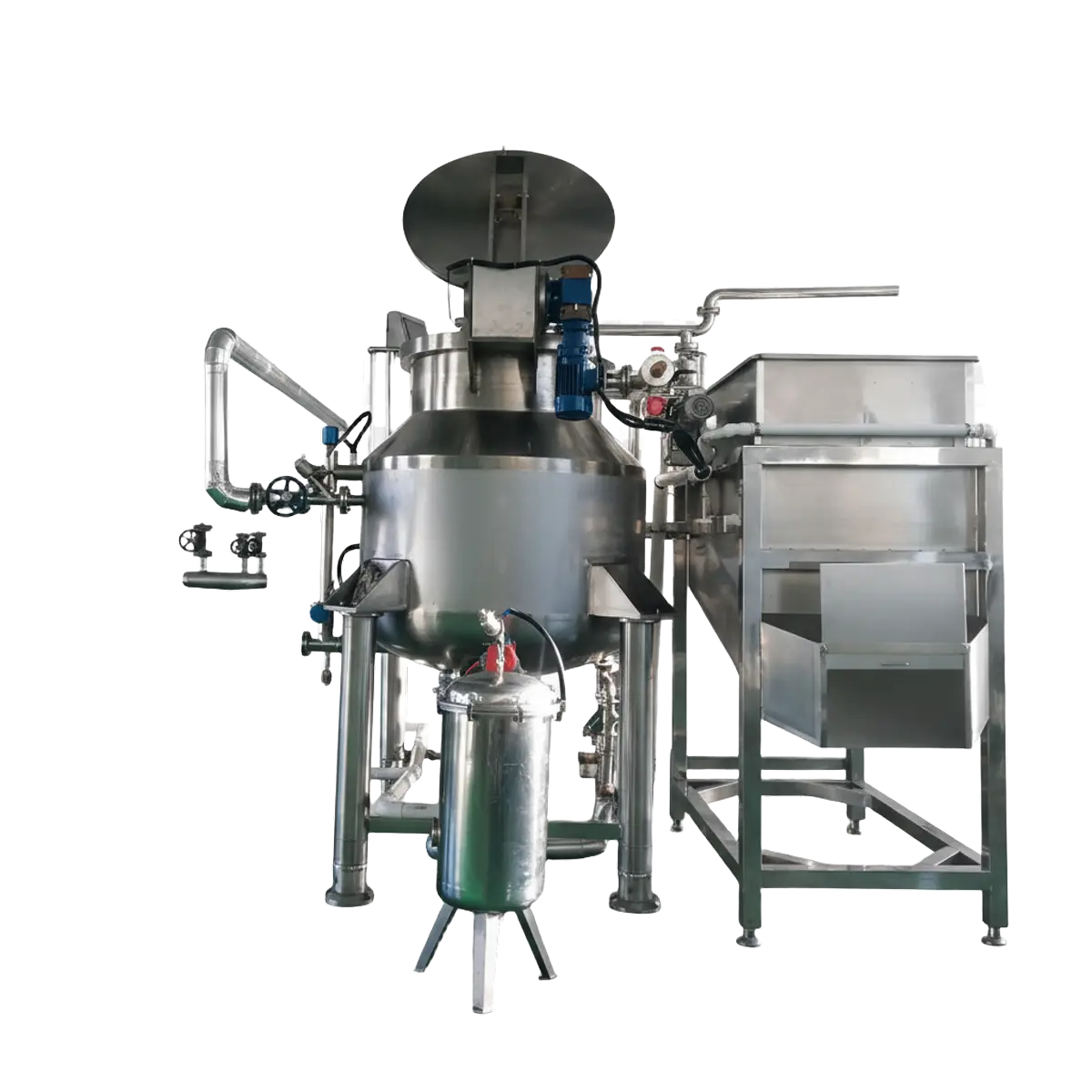
Vacuum frying takes the opposite design approach. The product is placed in a sealed stainless-steel vessel, the chamber is evacuated, and frying happens at 80–100 °C — roughly half the temperature of atmospheric deep frying. At this temperature, whole fruit and vegetable slices cook through without burning, sugars caramelize gently instead of scorching, and the natural color, shape, and much of the nutrient profile survive the process.
The batch cycle is straightforward: load the basket, pull vacuum, fry, then centrifugal de-oiling spins surface oil off the product while the chamber is still under vacuum, and finally discharge. No coating, no batter, no breading — the slice goes in and comes out a crisp chip with its original shape intact.
This is a batch machine, not a continuous line. Supreme Beast's vacuum fryer range covers three batch sizes: the QS-VF100 at 100 KG per batch, the QS-VF150 at 150 KG per batch, and the QS-300 at 300 KG per batch. A single machine plus utilities is a complete production unit — load, fry, de-oil, discharge, repeat. For buyers on vf.freezevacuumfry.com, that single-machine logic is the core of the business case: you scale by adding vessels, not by redesigning the line.
Product fit: a side-by-side comparison
The two technologies rarely compete for the same product. The decision table below makes the split concrete:
Air frying vs vacuum frying — product and buyer fit
| Dimension | Industrial air frying | Vacuum frying |
|---|---|---|
| Best-fit products | Coated and battered products: breaded chicken, fish portions, vegetable patties | Whole fruit and vegetable snacks: apple, banana, jackfruit, sweet potato, okra chips |
| Process key | Coating build-up + controlled oil application + high-airflow impingement cooking | Low-temperature frying (80–100 °C) under vacuum + centrifugal de-oiling |
| Product form | Reformatted, coated, frozen-ready items | Original slice form preserved; color and shape retained |
| Typical buyer | Large processors running continuous lines for EU/US retail and foodservice | Startups and mid-size processors in Southeast Asia building natural snack brands |
| Investment level | Full multi-stage line: coating, cooking, spiral freezing, packaging | Single batch machine at 100–300 KG per batch |
Notice where each technology's "strength" comes from. Air frying's advantage, per JBT Marel's claims, is fat reduction on products that would otherwise be deep-fried in a bath — the comparison is coated products cooked with less oil, not a different product entirely. Vacuum frying's advantage is making snack products that cannot be made any other way: a 3 mm apple slice cannot survive 170 °C oil; at 80–100 °C under vacuum, it becomes a premium chip.
The buyer-tier row matters as much as the product row. A continuous air frying line presupposes the buyer already runs at continuous-line scale — product development labs, freezing capacity, frozen logistics. Vacuum frying's batch format fits a different trajectory: a regional processor or startup that wants to launch a fruit-chip brand with one machine and grow capacity batch by batch.
Investment and buyer profile
Capital commitment is where the two paths diverge most sharply. An industrial air frying line is a line-level purchase: coating equipment, oil application, impingement oven, spiral freezer, and integrated packaging must be specified, installed, and commissioned as a system. That means line-layout engineering, a larger plant footprint, and a longer project timeline — appropriate for buyers whose volumes already justify continuous production.
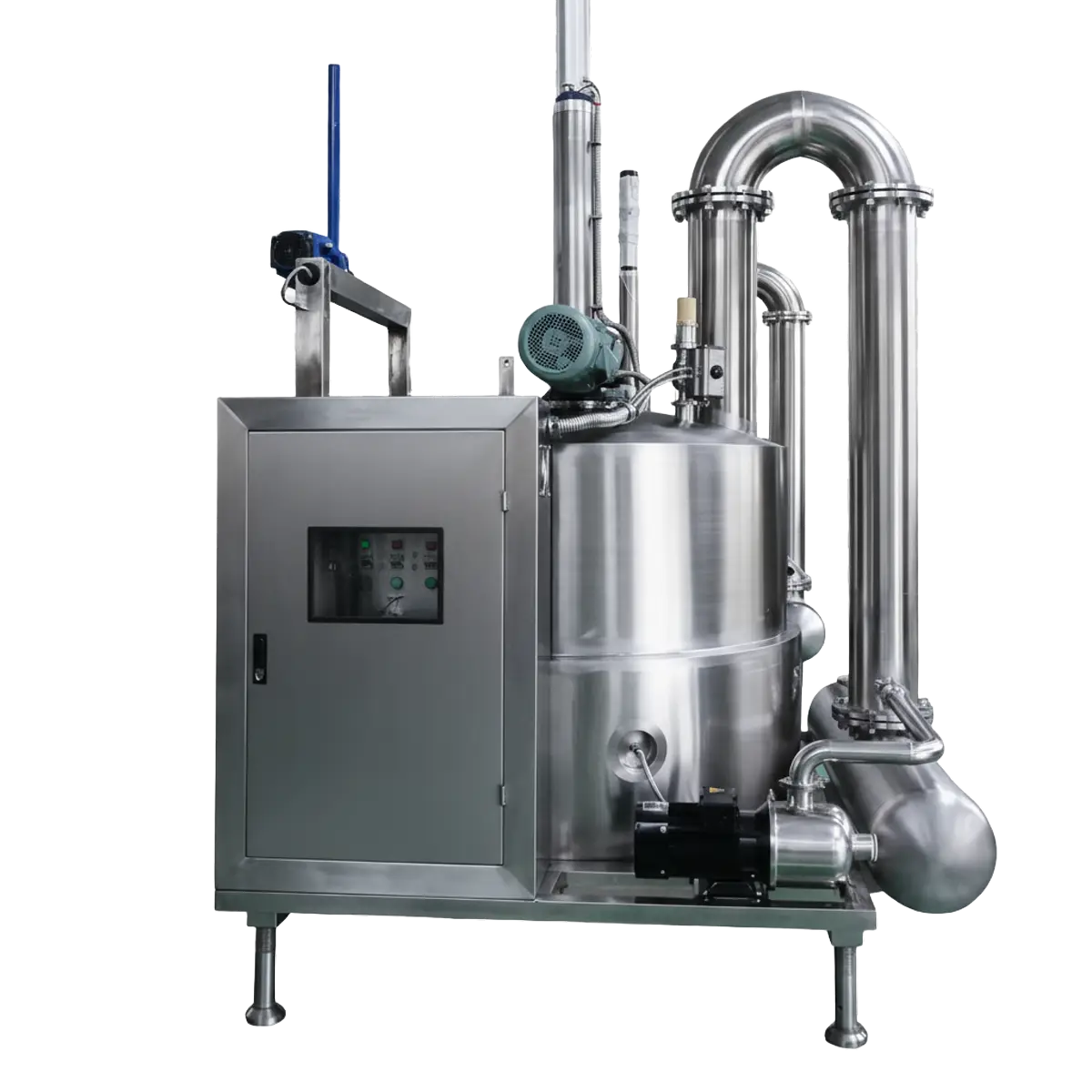
A vacuum fryer is a machine-level purchase. The QS-VF100, QS-VF150, or QS-300 arrives as a self-contained unit with its vessel, vacuum pump, heating, filtration, and controls. The commercial terms are correspondingly simpler: a 1-year warranty and approx. 3-month lead time from order to shipment are the standard business considerations, alongside utilities (power, cooling water) and oil and packaging supplies.
Neither path is "cheaper" in the abstract — the right question is cost per unit of your product at your volume. A startup running 500 KG of fruit chips per day has no use for a continuous coated-product line; a major poultry processor has no use for a batch fruit-chip vessel. Match the equipment architecture to the business, and the investment case usually resolves itself.
Specifications are for reference only and are subject to the final supplied equipment.
Which should you choose?
Run through this checklist with your actual product portfolio — the honest answers point to the right technology:
- Is the product coated or battered? Yes → you are in air frying territory; the whole coating stage exists for your product. No, the product is a whole fruit or vegetable slice → vacuum frying is the natural process.
- What is the target market? Frozen coated proteins for EU/US retail or foodservice pair with a cook-freeze-pack line. Shelf-stable natural fruit and vegetable snacks for Southeast Asian retail pair with batch vacuum frying.
- What is the budget and footprint? A multi-stage continuous line is a line-level investment in space, utilities, and commissioning. A 100–300 KG batch vacuum fryer is a single-machine investment — start with one vessel and add capacity as demand grows.
- What does the product development look like? Coated products need recipe and coating formulation work plus line trials. Vacuum-fried products need slicing, pre-treatment, and frying-curve development per fruit or vegetable — different expertise, different trial batches.
If the checklist gives a mixed answer — a diversified snack portfolio, say — that is normal. Many established snack producers eventually run both: coated lines for their protein range and batch vacuum fryers for their fruit and vegetable range, in separate hygiene zones. The technologies are complementary, and a factory can be too.
Frequently asked questions
Is air frying healthier than vacuum frying?
The answer depends on the product, not the technology. Air frying, as described in JBT Marel's announcement, reduces oil pick-up on coated products — JBT Marel claims up to 50%+ reduction in oil pick-up versus conventional frying of coated products. Vacuum frying, meanwhile, lets oil-sensitive products such as fruits and vegetables be fried at 80–100 °C, keeping sugar caramelization low and oil uptake per batch moderate. A coated chicken strip is never going to compete with an apple chip on fat content; compare within the product category.
Can one machine do both air frying and vacuum frying?
No. Industrial air frying as JBT Marel describes it is a continuous line with coating, oil application, impingement cooking, spiral freezing, and packaging stages; vacuum frying is a batch pressure-vessel process under vacuum at low temperature. The physics, product flows, and line layouts are fundamentally different. A plant can run both technologies side by side, but each needs its own line or machine.
What about oil content in vacuum-fried snacks?
Vacuum-fried snacks do contain oil — they are fried snacks. The advantage is the process window: frying under vacuum at 80–100 °C keeps whole fruit and vegetable slices from burning, and centrifugal de-oiling after frying removes surface oil while the chamber is still under vacuum. The result is a shelf-stable crisp with moderate fat content, typically sold as a healthier indulgence rather than as a low-fat product.
Where should a startup begin: air frying or vacuum frying?
Start from your product. If your business plan centers on whole fruit or vegetable chips, vacuum frying is the practical entry point: a single batch machine such as the QS-VF100 (100 KG per batch) or QS-VF150 (150 KG per batch) starts production at a manageable investment with approx. 3-month lead time. If your product is a coated, protein-based frozen item, you are looking at a multi-stage line — a larger commitment in budget, space, and commissioning.
Can both technologies work in one factory?
Yes, and for a diversified snack producer this is a common setup. The air frying line and the vacuum fryer occupy different process areas: coating and impingement cooking on one side, vacuum batch frying of fruit and vegetable snacks on the other. They share utilities and packaging, not equipment. Plan the factory layout so product flows never cross — raw coated proteins and ready-to-eat fruit snacks have very different hygiene zones.
Planning a snack line — vacuum or air?
Tell us your product and target capacity — we'll help you size the right vacuum frying setup or discuss how it complements an existing line.
Specifications are for reference only and are subject to the final supplied equipment.