Why berries suit freeze drying
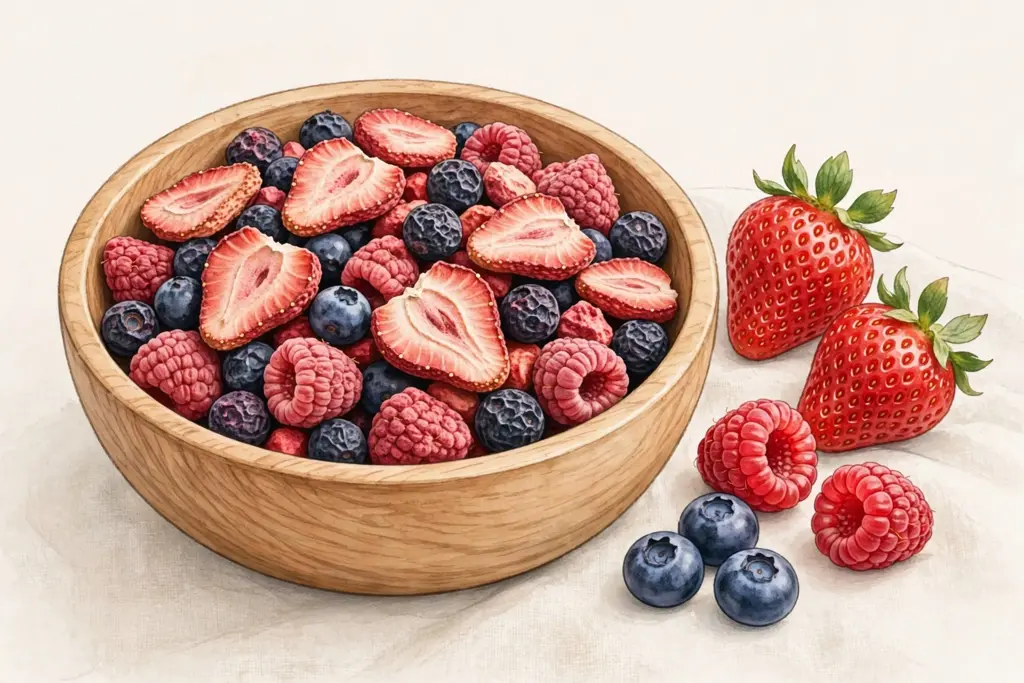
A berry is hard to dry well: mostly water, wrapped in a thin skin, bruising at a touch — and its value sits in qualities heat destroys, namely shape, color, and aroma. Hot-air drying shrinks and darkens berries, wrinkling the skin and flattening the aroma. Freeze drying takes a different route: the berry is frozen solid, then under vacuum the ice turns directly into vapor — sublimation — without passing through liquid water, so the frozen framework holds its shape.
The result is a light, crisp berry with shape, color, and aroma largely intact, rehydrating quickly in liquid — a premium product, not a commodity dried fruit, that looks and smells like berries and eats with a clean, airy crunch.
Berry by berry: preparation notes
Not all berries prepare the same way: size, skin, and softness decide the cut, sorting, and loading — and preparation is half the quality battle, since drying only preserves what preparation protected.
- Strawberry. The largest and softest common berry, strawberries are usually hulled and halved, or sliced, before drying. Cutting opens the flesh so water leaves evenly; a whole strawberry dries unevenly, the center lagging behind. Halves and slices also give a flat, attractive piece for cereal, yogurt, and chocolate. Sort strictly: an underripe strawberry dries pale and tart, a bruised one shows plainly in the pack.
- Blueberry. Blueberries are usually dried whole, keeping their neat round shape and bloom. The challenge is the skin: a blueberry's waxy skin slows water loss, so whole berries need a well-designed cycle and careful size sorting — mixed sizes will not finish together. Confirm the result with your own product testing.
- Raspberry. Raspberries are the most fragile berry here: each one is a cluster of tiny drupelets that falls apart under rough handling. Handle them gently from washing through loading, and dry them whole to protect that shape. The payoff is a hollow, crisp, ruby-red piece that rehydrates close to fresh — but expect more breakage.
- Blackberry. Blackberries sit between blueberry and raspberry: larger and firmer than a raspberry, with a similar clustered structure. Usually dried whole, they carry a skin that slows water loss like blueberries, so uniform sizing and a patient cycle matter.
The shared rule across all four: sort before drying, not after. Remove damaged, underripe, and mis-sized berries before they enter the dryer — a sorted batch dries more evenly and wastes less on rejects. Wash gently and briefly, since berries soak up surface water quickly, and drain well before loading.
The freeze drying chain
Industrial freeze drying is a chain of four stages, each protecting the next. Rushing one stage shows up as uneven dryness, collapsed pieces, or berries that lose crispness too fast.
1. Sorting and washing — protect the raw berry
Sort for ripeness, size, and damage, wash gently, and drain well. Berries that enter the line damaged or underripe leave it that way — drying preserves quality, it does not create it.
2. Pre-freezing — lock the structure in place
The prepared berries are spread on trays and frozen solid, locking the structure in place. The water inside becomes ice, and that ice leaves in the next stage. Load trays evenly — piled berries freeze slowly and dry unevenly.
3. Primary drying — sublimation under vacuum
Under vacuum, gentle heat is applied and the ice turns directly into vapor, leaving the berry's framework behind. This is the heart of the process, and why the berry keeps its shape: the water leaves without ever becoming liquid, while 4-zone heating to within ±0.1°C keeps temperatures even across trays.
4. Secondary drying — remove the last bound water
After the ice is gone, a small amount of water remains bound tightly to the berry's solids. Secondary drying, at a controlled temperature up to the equipment's 80°C maximum, drives this residual water off — the stage that makes the berry truly crisp and stable. Verify dryness with your own QC before packing: your own product testing is the final check.
Run in this order, the chain is forgiving of small variations in raw material. Most quality complaints trace back to preparation or loading, not the dryer itself.
Product forms: whole, pieces, and powder
One drying run can feed several formats, because grading and milling happen after drying — so one line can serve a snack buyer, a cereal buyer, and an ingredient buyer at once.
- Whole berries and halves. The premium format. Whole blueberries, whole raspberries, and strawberry halves sell as snacks and as visible toppings on yogurt, cereal, and chocolate, commanding the best price.
- Pieces and crumble. Berries that break during handling, or are cut deliberately after drying, become pieces and crumble for baking, cereal inclusions, and trail mixes — turning rejects into a saleable product.
- Powder. Milled freeze dried berries become a natural color and flavor ingredient for yogurts, drinks, instant foods, and baked goods — adding real fruit color and flavor without added water.
Decide the format mix before the season starts, not after the harvest arrives.
Packing and moisture discipline
A freeze dried berry is dry, light, and porous — three traits that make packing the most underestimated step in the line.
- Pack promptly. Dry, porous berries pull moisture from the air quickly — move them from dryer to packing without delay.
- Use moisture-barrier packaging. The pack is the berry's only defense against humidity: a pouch with a genuine moisture barrier and a reliable seal.
- Protect from light and oxygen. Light fades bright color, and oxygen degrades flavor over time. Opaque packaging, plus oxygen absorbers or nitrogen flushing where your specification calls for it, keeps the pack fresh.
- Handle the finished pack gently. Freeze dried berries are fragile, and raspberries in particular crumble under rough handling — a crushed bag means broken berries.
- Verify dryness with your own QC. Do not rely on a fixed rule of thumb for when a batch is done: check texture and appearance, run your own product testing, and record the result for the next batch.
Applications for snack and ingredient producers
Freeze dried berries cross the line between snack and ingredient, so one product serves many buyers:
- Snacks. Whole berries and berry mixes, sold alone or blended with nuts and seeds — the simplest product.
- Cereal and yogurt toppings. Light, colorful, and rehydrating in milk or yogurt, they add fruit, color, and crunch without adding water.
- Baking. Pieces and crumble survive baking better than fresh berries, which release water into the dough.
- Instant foods. In instant porridge, drinks, and ready meals, they rehydrate quickly and bring real fruit.
- Pet treats. Where a market includes pet food, they work as a natural, single-ingredient treat or topper.
The common thread: in every use, the buyer pays for the berry's shape, color, and aroma surviving the process.
Choosing equipment size
A programmable industrial freeze dryer is the right tool for a berry line, and the QS-FD series covers the range most producers need:
QS-FD series — industrial freeze dryers
| Model | Tray area | Trays | Power | Dimensions | Batch |
|---|---|---|---|---|---|
| QS-FD-20 | 20.16 sqm | 84 | 35 kW | 4500x1300x1400 mm | ~200 kg |
| QS-FD-100 | 103.68 sqm | 432 | 135 kW | 7000x4000x2300 mm | ~1 t |
| QS-FD-200 | 207.36 sqm | 864 | 135 kW listed | 12000x4000x2300 mm | ~2 t |
- Shared platform: SUS304 square chamber, -60°C, R404A/507, 4-zone heating to ±0.1°C (max 80°C), Siemens S7-200 PLC with CN/EN touchscreen, Roots + screw pumps, food-grade silicone seals.
- Standard terms: 1-year warranty, approximately 3-month lead time.
Start from your target output and work backward: how many batches per shift, and how much room you want to grow. A machine that fits today's volume with room to grow is cheaper than one you outgrow in a year.
Specifications are for reference only and are subject to the final supplied equipment.
Frequently asked questions
Why do berries suit freeze drying so well?
Berries are delicate, high in water, and valued for the qualities other drying methods damage: shape, color, and aroma. Freeze drying removes water by sublimation while the berry stays frozen, giving a light, crisp berry close to fresh.
How should strawberries differ from whole small berries in preparation?
Strawberries are large and soft, so they are usually hulled and halved or sliced before drying, opening the flesh so water leaves evenly. Small berries such as blueberries and blackberries are usually dried whole, but their skins slow water loss — so sort carefully and confirm the result with your own product testing.
What product forms can freeze dried berries take?
Whole berries and halves are the classic snack and topping formats, pieces and crumble suit baking and cereal inclusions, and milled powder works as a color and flavor ingredient. One drying run can feed several formats, since grading and milling happen after drying.
Which freeze dryer size fits a berry line?
It depends on target output. A QS-FD-20 (20.16 sqm, 84 trays, about 200 kg per batch) suits startups and pilot production; a QS-FD-100 (103.68 sqm, 432 trays, about 1 tonne per batch) fits established producers; a QS-FD-200 (207.36 sqm, 864 trays, about 2 tonnes per batch) serves high-volume operations — all sharing the SUS304 chamber and Siemens S7-200 PLC platform.
Plan your freeze dried berry line
Tell us your target output and which berries you process — we'll help you size the freeze dryer and plan the line. Explore the range on our freeze dryer page.
Specifications are for reference only and are subject to the final supplied equipment.