Why freeze drying fits yogurt bites
A yogurt bite starts life as a soft drop — piped or deposited from a yogurt formulation onto a tray. The commercial challenge is turning that drop into a shelf-stable snack without destroying what makes it appealing: its shape, its clean dairy flavor, and a texture that melts rather than crunches like a cracker.
Freeze drying answers this better than any heat-based method, for three reasons:
- Shape retention. Because water leaves as vapor directly from ice, the drop never passes through a liquid phase where it could slump or spread. The finished bite is the same shape that left the depositor — only lighter.
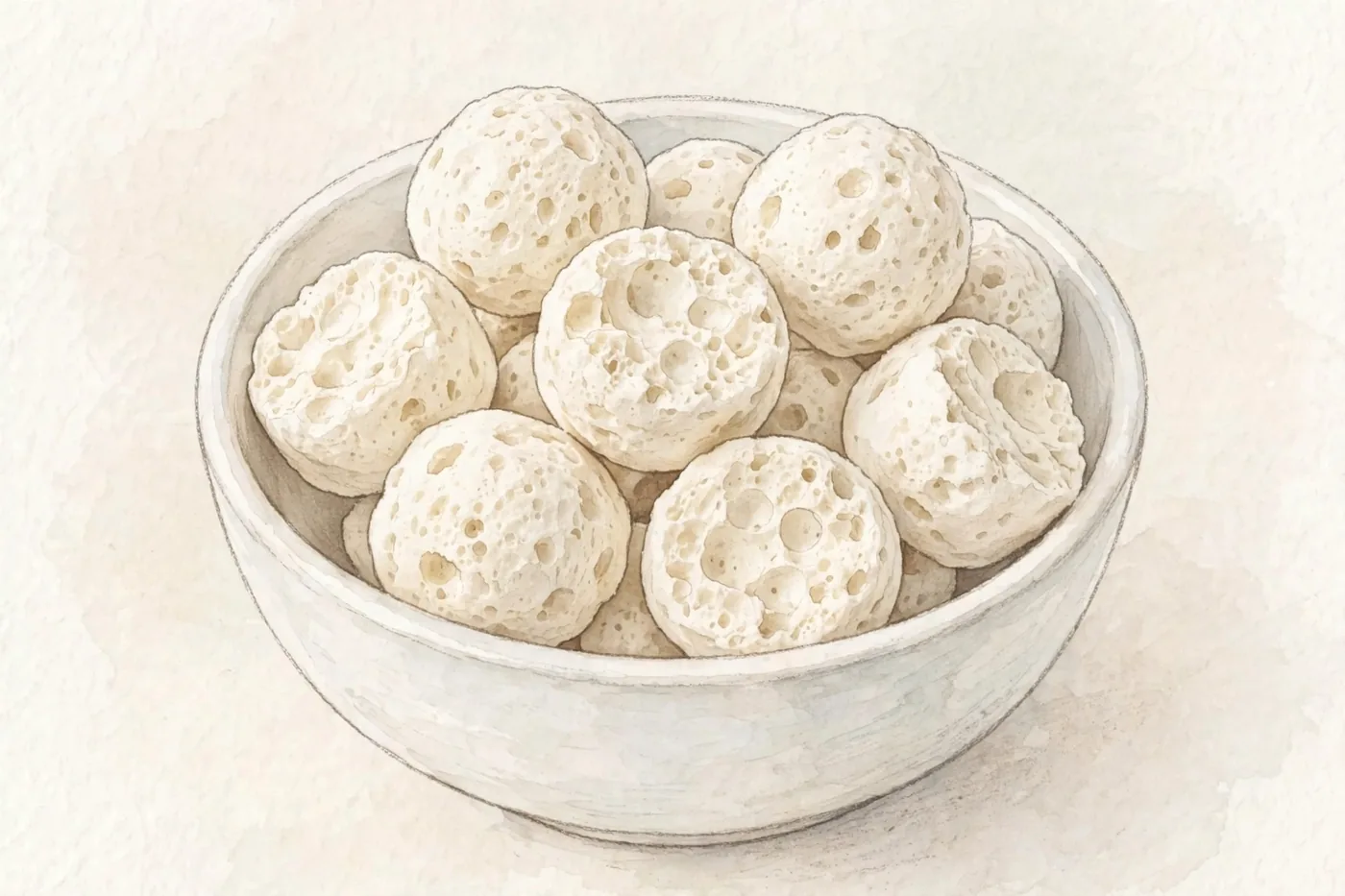
- Porous, melt-in-mouth texture. The ice crystals leave behind a network of tiny pores as they sublimate. That open structure is what gives freeze-dried yogurt bites their characteristic light crunch that dissolves quickly — a texture hot-air drying cannot produce, because heat collapses the structure as it dries.
- Room-temperature stability. Once dried and packed in moisture-barrier packaging, yogurt bites need no refrigeration. That single fact unlocks e-commerce, export, and retail channels that chilled yogurt can never reach.
This is why yogurt bites have become a recognized application for industrial freeze drying, alongside fruit, pet treats, and instant foods: the process doesn't just preserve the product, it creates the product's defining texture.
The process chain, step by step
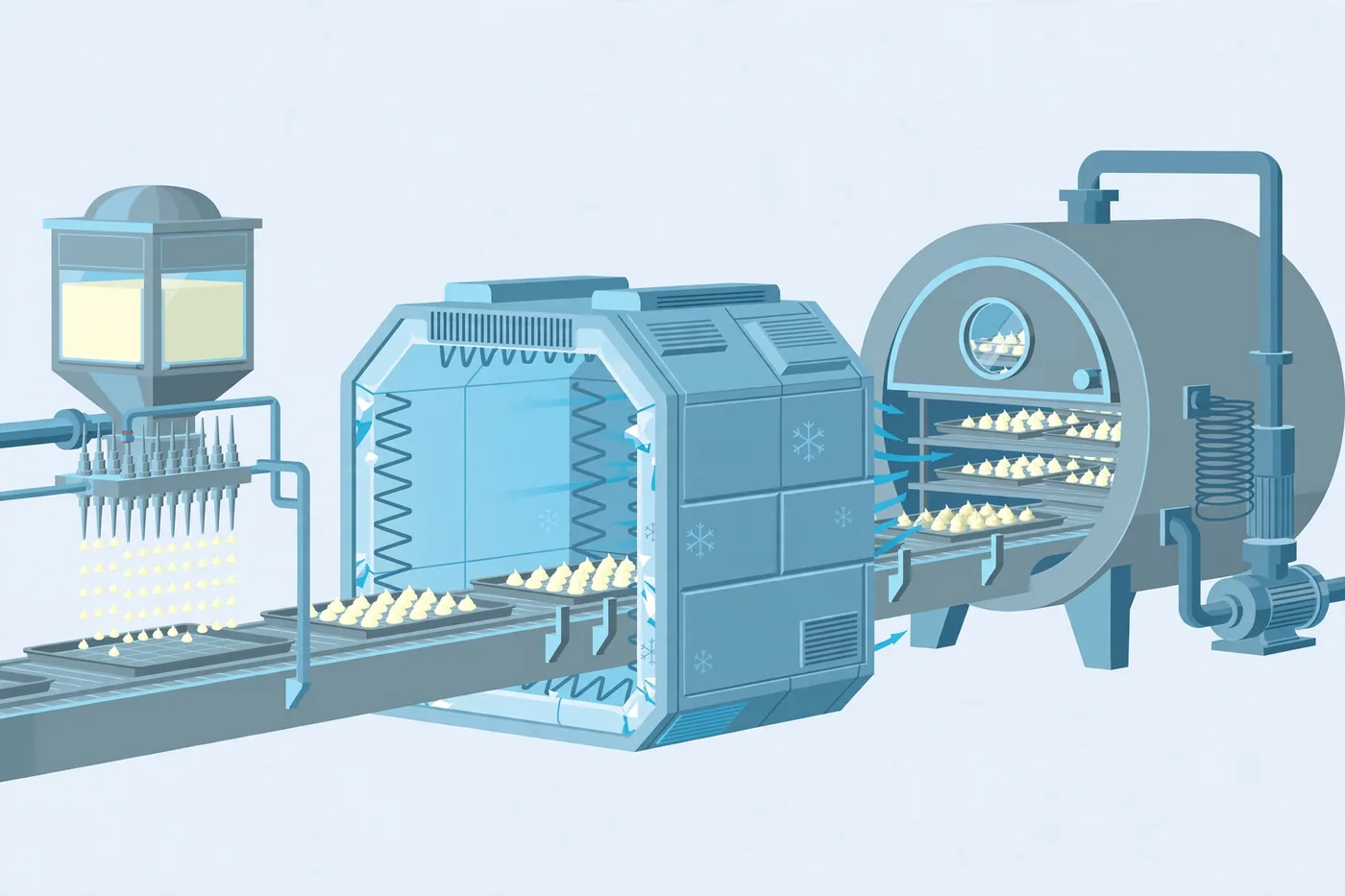
A yogurt bites line has five stages. Each one sets up the next; a weakness early in the chain cannot be fixed later.
1. Formulation
Everything starts with the yogurt base. The formulation's solids content is the variable that matters most for drying: enough milk solids — plus any fruit, inclusions, or stabilizers in the recipe — build a frozen matrix strong enough to hold its shape through sublimation and give the finished bite its structure. This is product development work, done with your food technologist, and it should be locked before you scale — reformulating after the line is built is expensive.
2. Drop forming (depositing)
The formulated yogurt is deposited as uniform drops onto trays. Uniformity here is not cosmetic: drops of consistent size freeze at the same rate and dry at the same rate, which is what makes a whole tray finish together. A depositor with steady portion control beats manual piping the moment volumes grow beyond pilot scale.
3. Blast freezing
Trays of fresh drops go into a blast freezer and are frozen solid before they ever see the dryer. Freezing fast matters: rapid freezing forms small ice crystals, and small crystals leave fine, even pores — the foundation of the light texture. Slow freezing grows large crystals that leave coarse, fragile voids. The drops must be frozen through, not just crusted on the surface, or the centers will collapse during drying.
4. Freeze drying
Frozen trays are loaded into the freeze dryer chamber. Under deep vacuum, with the product held below freezing, ice sublimates directly to vapor — this is primary drying. Controlled warming then drives off the remaining bound moisture — secondary drying. The dryer runs a programmed recipe: vacuum depth, shelf temperatures, and stage timing tuned to the product. This is where the machine's control system earns its keep — four-zone independent heating control, accurate to ±0.1 °C, lets different tray zones follow the curve the product actually needs.
5. Packaging
Dried bites leave the chamber crisp and extremely dry — and immediately start pulling moisture from the air. The transfer from dryer to packer should be fast and, ideally, run as a low-humidity operation. Pack promptly into moisture-barrier packaging: pouches with proper seals, and desiccant or nitrogen flushing where the product specification calls for it. Packaging is not an afterthought; for a hygroscopic product like this, it is the step that protects everything the dryer achieved.
Process controls that decide quality
Two manufacturers can run the same five stages and get visibly different bites. The difference is control over a handful of variables:
- Freezing rate. As above: fast freeze, fine pores, better texture. This is the single highest-leverage variable in the whole chain.
- Drop size consistency. Mixed sizes mean mixed drying endpoints — small drops over-dry while large ones stay damp in the middle. Portion control at the depositor pays off in the dryer.
- Tray loading. Evenly spaced drops with air gaps dry evenly; crowded trays trap vapor and dry unevenly. Respect the tray layout the recipe was developed on.
- Drying endpoint discipline. Pulling the batch too early leaves residual moisture that softens the bite in the pack; running too long wastes energy and chamber time. The endpoint is set during recipe development and then followed, not guessed each batch.
- Moisture discipline after drying. Every minute the dried bites sit in humid air, they reabsorb water. Dry-room handling and prompt packing are process controls, not housekeeping.
Notice what is not on this list: exotic equipment. Yogurt bites reward process discipline far more than machinery novelty. A standard batch freeze dryer run with a well-developed recipe outperforms a fancier machine run carelessly.
Equipment considerations for yogurt bites
For the drying stage itself, a batch freeze dryer with precise recipe control is the right tool. The QS-FD series covers the range most yogurt bite producers need:
- QS-FD-20 (~200 kg per batch, 20.16 m², 84 trays) — startups, pilot production, and recipe development.
- QS-FD-100 (~1 ton per batch, 103.68 m², 432 trays) — established brands running regular production.
- QS-FD-200 (~2 tons per batch, 207.36 m², 864 trays) — high-volume lines.
All three share the same core platform — SUS304 chamber, −60 °C two-stage refrigeration, four-zone heating control to ±0.1 °C, and a Siemens S7-200 PLC with Chinese/English touchscreen — so a recipe developed on the smallest machine transfers directly to the larger ones when volume grows. Supporting equipment is straightforward: a depositor, a blast freezer capable of freezing the drops solid, and a packing line with moisture-barrier capability. The dryer is the heart of the line, but the freezer and the packer decide whether its work survives to the consumer.
Specifications are for reference only and are subject to the final supplied equipment.
Frequently asked questions
Why freeze dry yogurt bites instead of baking or air-drying them?
Baking and hot-air drying shrink and brown the yogurt drop, collapsing its shape. Freeze drying removes water by sublimation while the drop stays frozen, so the piece keeps its deposited shape and develops a light, porous crunch instead of a hard, shriveled pellet.
Does freeze drying keep the yogurt drop's shape?
Yes — that is the main reason manufacturers choose it. Because ice turns directly to vapor without a liquid phase, the drop's structure never collapses. The finished bite is essentially the same shape that left the depositor, only lighter and crisp.
What should I know about the yogurt formulation for freeze drying?
Solids content is the key variable: a formulation with enough milk solids and any added fruit or inclusions forms a stronger frozen matrix and a crisper dried piece. Work with your formulation toward a drop that holds its shape through freezing, and run pilot batches before committing to production volumes.
How should freeze-dried yogurt bites be packaged?
Like all freeze-dried foods, yogurt bites are hygroscopic — they pull moisture from the air and go soft if left unprotected. Pack them promptly in moisture-barrier packaging, and handle the transfer from dryer to packer as a dry-room or low-humidity operation.
Which freeze dryer size fits a yogurt bites line?
It depends on target output. A QS-FD-20 (about 200 kg per batch) suits startups and pilot production; a QS-FD-100 (about 1 ton per batch) fits established brands; a QS-FD-200 (about 2 tons per batch) serves high-volume lines. All three share the same Siemens S7-200 control platform, so recipes transfer between sizes.
Plan your yogurt bites line
Tell us your target output and product format — we'll help you size the freeze dryer, set the drying recipe logic, and plan the full line from depositor to packer. Explore the range on our freeze dryer page.
Specifications are for reference only and are subject to the final supplied equipment.