
Home / Insights / Freeze Drying and Vacuum Frying for Pet Food
PILLAR GUIDE
Freeze Drying and Vacuum Frying for Pet Food
Freeze drying and vacuum frying for pet food: which technology fits treats, toppers and ingredients, and how to size the line.
Why pet food is a real market for both technologies
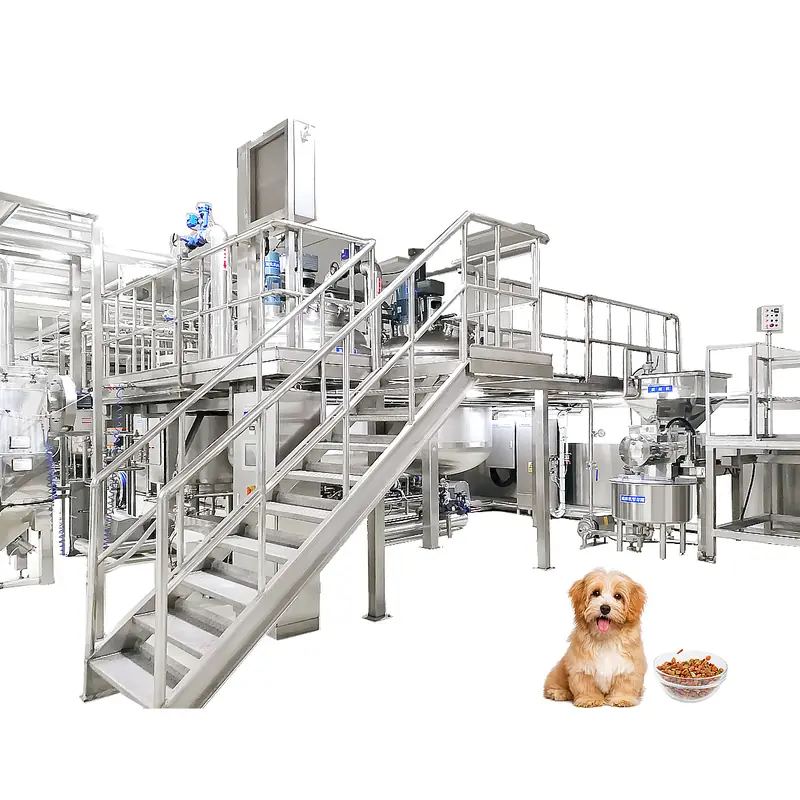
Pet owners buy the way food buyers buy: they read labels, they want to see real ingredients, and they pay a premium for products that look like food rather than extruded shapes. Both of our technologies fit that market, in different places. Freeze drying makes treats and toppers that keep the shape and colour of the original meat, fruit or vegetable. Vacuum frying makes crisp treats from fruit, vegetables and meat snacks. This guide covers both, so you can see where your product belongs.
Freeze drying for pet treats and toppers
Freeze drying is the stronger fit for premium pet products. The process freezes the product and removes water by sublimation, under vacuum, without heat — so a cube of chicken, a slice of liver or a piece of fruit keeps its shape and colour, and rehydrates quickly in a bowl. That matters for toppers and mixers, which owners expect to look like real food.
Our freeze dryers run from about 200 kg per batch on the QS-FD-20 (20.16 m², 84 trays of 400 × 600 mm) to about 1 tonne on the QS-FD-100 (103.68 m², 432 trays) and about 2 tonnes on the QS-FD-200 (207.36 m², 864 trays). The cold trap holds −60 °C on a two-stage refrigeration system, heating runs in four zones accurate to ±0.1 °C up to 80 °C, and a Siemens S7-200 PLC repeats the same cycle every batch. The chamber is SUS304 stainless steel with food-grade silicone seals — the same standard as our human-food machines, because pet food deserves the same hygiene.
Vacuum frying for pet treats
Vacuum frying fits crisp pet treats: vegetable crisps, fruit chips and meat snacks that are eaten dry, straight from the bag. The product fries at 80–100 °C under vacuum, and in-chamber centrifugal de-oiling spins the oil out before the chamber opens, keeping finished oil content under 18%. For a treat, low oil content matters twice: the owner reads the label, and a greasy treat stains hands and floors.
Batch sizes are 100, 150 and 300 kg of raw material per batch on the QS-VF100, QS-VF150 and QS-300. The vessel is 304 stainless steel, 6 mm thick-walled, and the controls are a Delta PLC with an MCGS touchscreen, so each product runs on a repeatable recipe.
Which technology for which product
| Product | Technology | Why |
|---|---|---|
| Meat treats and toppers | Freeze drying | Keeps shape, colour and texture; rehydrates in the bowl |
| Fruit and vegetable treats | Either | Freeze drying for premium look; vacuum frying for crisp snacks |
| Meat snacks and jerky-style treats | Vacuum frying | Crisp finish, lower cost per batch |
| Yogurt bites and dairy treats | Freeze drying | Only freeze drying keeps the structure |
| Meal toppers and mixers | Freeze drying | Shape and rehydration matter most |
If your range is premium — single-ingredient treats, raw toppers, food an owner can recognise — freeze drying is usually the right technology even though it costs more per batch. If your range is everyday crisp treats sold on price, vacuum frying is usually the right call.
Sizing the line
Start from the raw material you can reliably supply, not from the biggest machine. A 100 kg vacuum frying batch running every day earns more than a 300 kg batch standing idle. The same rule applies to freeze drying: a QS-FD-20 running full at about 200 kg per batch beats a QS-FD-100 running half-full. Growth is by adding a machine or moving up one size, not by buying the largest machine on day one.
Both technologies share preparation, packing and distribution, so a mixed line — one dryer and one fryer — is a normal project for us. Preparation is where the labour sits: cutting, loading trays or baskets, unloading and packing. Cost labour across the whole line, not per machine.
Buying questions
Ask for a process flow and a full equipment list for your product. Confirm delivery time (about 3 months), warranty (12 months), payment (50% deposit, 50% before shipment) and installation terms (our engineers on site at USD 200 per person per day, travel and accommodation by the buyer). Ask whether the packaging machine is included — it is not always part of a line, and it must be explicit on the quotation.
And test before you buy. We run free sample tests in our factory — freeze drying and vacuum frying — and you pay shipping only. Put a freeze-dried treat and a vacuum-fried treat on the table, and let your buyers tell you which one they will pay for.
Frequently asked questions
Which technology is better for pet treats?
It depends on the product. Premium single-ingredient treats and toppers fit freeze drying; crisp everyday treats fit vacuum frying. Both are real pet-food technologies, and many producers use both.
Does pet food need the same hygiene as human food?
Yes, on our machines. The chambers are SUS304 stainless steel with food-grade silicone seals — the same standard as our human-food lines. Buyers should ask any supplier what grade of steel and seals the machine uses.
What batch size should I start with?
Start from the raw material you can reliably supply every week. A small machine running full beats a large machine running half-full, on both technologies.
Can I run pet food and human food on the same machine?
Not in the same production run — the two should be scheduled separately with cleaning between them. The machine is the same; the production plan separates them.
Can I test my product before buying?
Yes. We run free sample tests in our factory for both technologies — you pay shipping only. Test the same product both ways and decide on evidence.
Supporting guides
Deeper reading from our knowledge base on this topic: