On this page
Why capacity planning comes first
A freeze dryer is a batch machine with a fixed capacity per cycle, and each cycle is long — drying is measured in hours, not minutes. That combination makes capacity the hardest thing to change after purchase. Undersize the dryer and your production line waits for the machine; oversize it and you paid for steel, floor space and power that sits idle. Both mistakes are expensive to fix, because replacing or adding industrial equipment takes months of lead time.
Capacity planning also decides the machine's floor space, power supply, tray-loading crew size, and raw-material purchasing rhythm. Get the capacity right first, and every downstream decision gets easier.
Start from finished output, not fresh input
The single most common planning error is sizing from fresh raw-material tonnage. Freeze drying removes water, and water is most of what you load. Vegetables, fruits and meats are predominantly water, so the gap between fresh input weight and dried output weight is large — and it varies widely by product. A buyer who plans around "we can buy 5 tons of fresh fruit a day" without converting to finished output is planning around the wrong number.
Always size from the sellable finished product target: kilograms of freeze dried output per day or per week. That is the number your customers pay for, the number your packaging line is rated for, and the only number that lets you compare dryer models fairly. From the finished target, the planning logic runs backwards:
- Weekly finished target ÷ batches you can run per week = finished output needed per batch.
- Output needed per batch ÷ the machine's per-batch output = the dryer size that fits.
- Per-batch output itself = shelf area × loading density × (1 − water content of your product).
The three inputs every calculation needs
Every capacity calculation, whether done on a napkin or in a spreadsheet, needs the same three inputs:
1. Finished-output target per period
Kilograms of dried product per day or per week, per product if you run several. Be specific about the mix: 500 kg/week of freeze dried strawberry slices and 200 kg/week of vegetable blends are two different capacity questions, not one.
2. Operating schedule
How many days per week and how many shifts per day the plant actually runs. Batches per week is decided by cycle time plus loading, unloading and cleaning time between cycles — our cycle time guide explains what stretches or shortens a cycle. A dryer that looks big enough at "3 batches a week" may fall short at the 5 you actually need.
3. Product mix and format
Piece size, thickness, and water content decide how much shelf area each kilogram of finished product needs. Thick-cut, high-water products occupy more tray space and dry longer per unit of output than thin, dense ones. If your product mix changes with the seasons, plan around the most demanding product in the mix — the average will leave you short in the hard season.

Mapping output to the QS-FD range
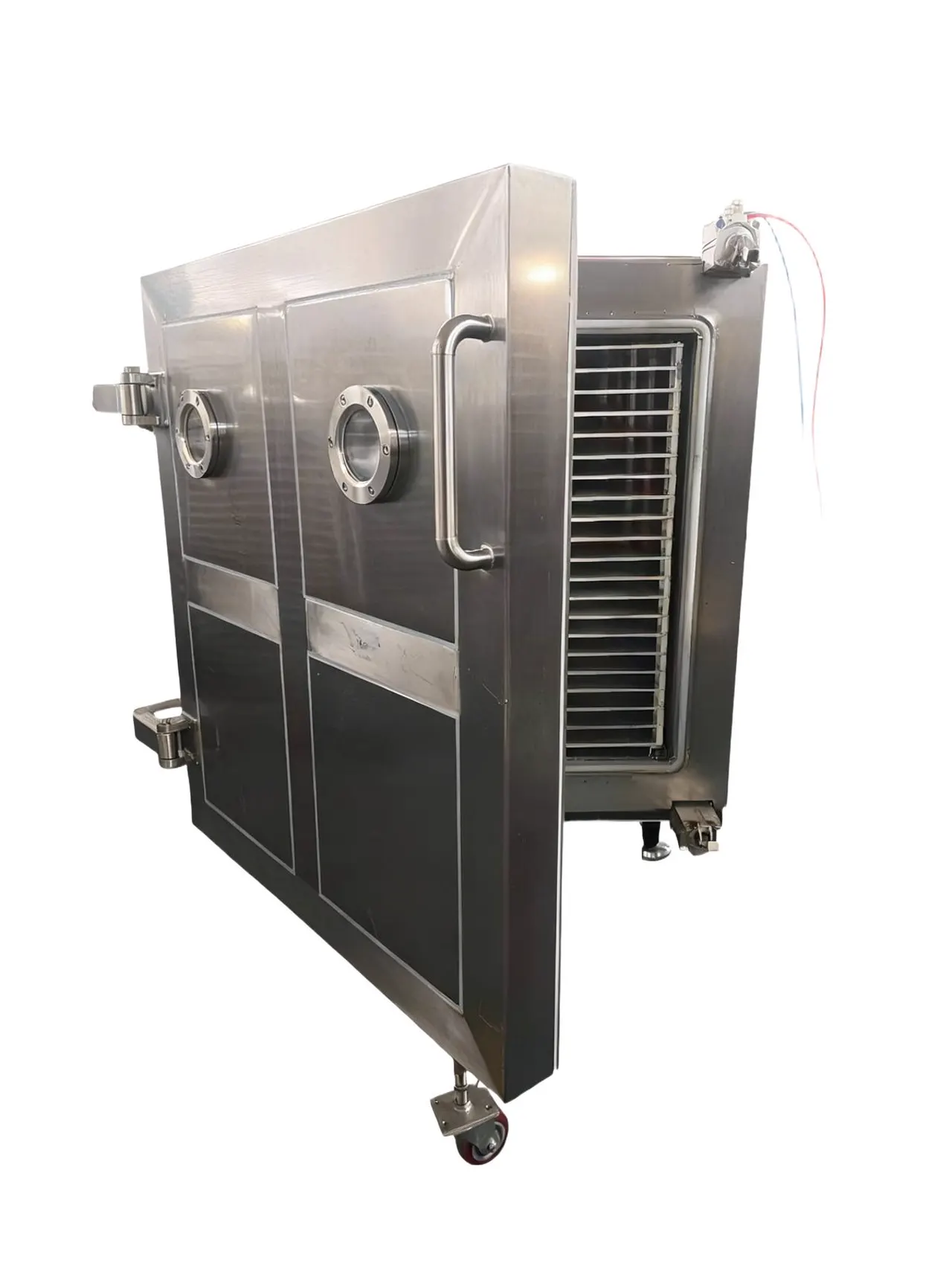
Once you have a per-batch output target, it maps directly to machine size. The QS industrial freeze dryer range covers three output tiers:
- QS-FD-20 — about 200 kg per batch. 20.16 m² of shelf area, 84 trays (400 × 600 mm each), 35 kW. The pilot, recipe-development and specialty-product choice.
- QS-FD-100 — about 1 ton per batch. 103.68 m² of shelf area, 432 trays, 135 kW, 7000 × 4000 × 2300 mm. The workhorse for dedicated production lines.
- QS-FD-200 — about 2 tons per batch. 207.36 m² of shelf area, 864 trays, 135 kW, 12000 × 4000 × 2300 mm. For high-volume and contract production.
All three share the industrial configuration: SUS304 square chamber, −60 °C two-stage refrigeration (R404A/R507), four-zone independent heating control (±0.1 °C, max 80 °C), Siemens S7-200 PLC with Chinese/English touchscreen, Roots plus screw vacuum pumps, food-grade silicone seals, and front-door loading. Actual average power draw runs around 60% of the nameplate rating in normal production. Our model-by-model comparison goes deeper into which tier fits which output band.
One large dryer or two smaller ones?
Buyers planning for growth often face this choice, and there is no universal right answer. The trade-offs are practical:
- Redundancy. With two machines, one can keep producing while the other is under maintenance or being cleaned. With one machine, a service stop is a full production stop.
- Staged investment. Two smaller units let you buy the first now and add the second when demand actually arrives, instead of betting the full capacity on day one.
- Product separation. Two chambers can run two different products or two different drying curves at the same time — useful for plants with diverse product lines.
- Simplicity. One large machine means one installation, one control system, one maintenance schedule — and usually a lower cost per unit of output.
- Space and utilities. Two machines need more floor space and more utility connections than one machine of equivalent total capacity.
A common middle path: size the first machine for today's confirmed demand with headroom, and reserve floor space and power capacity for a second unit later. That keeps the door open without paying for idle steel now.
Fitting the dryer into the weekly schedule
Capacity is not just "tons per batch" — it is batches per week, and the weekly schedule decides that number. A realistic batch cadence includes:
- Cycle time — the drying itself, decided by your product and its piece size. Validate with a trial, not a catalog.
- Loading and unloading — filling and emptying hundreds of trays (432 on a QS-FD-100, 864 on a QS-FD-200) takes real crew time and should be in the schedule, not assumed away.
- Cleaning between batches — especially when switching products, where cross-contamination and allergen control matter.
Multiply realistic batches per week by per-batch output, and you have the dryer's true weekly capacity. Compare it against your finished-output target — with a margin. Running at 100% of theoretical capacity every week leaves no room for maintenance or product changeovers.
Common capacity planning mistakes
- Sizing from fresh tonnage instead of finished output — the mistake this guide exists to prevent.
- Treating the nameplate batch figure as daily output — it is per batch, and batches take many hours plus turnaround time.
- Planning for the average product instead of the most demanding one in a seasonal mix.
- Forgetting the footprint — the machine dimensions (up to 12000 × 4000 × 2300 mm for the QS-FD-200) plus loading, unloading and service clearances need to be in the layout before the machine ships.
- No growth headroom — buying exactly today's capacity means the next order increase triggers a second purchase with a full lead time. Industrial freeze dryers typically carry around a 3-month lead time.
- Choosing on price alone without trial cycle data — a cheaper machine that needs longer cycles can cost more per kilogram of finished output over its working life.
Capacity planning checklist
- Finished-output target defined per product (kg/day or kg/week)
- Operating schedule fixed: days per week, shifts per day
- Trial cycle data for the most demanding product in the mix
- Per-batch output target calculated from the backwards formula
- Model selected with headroom for growth (or space reserved for a second unit)
- Floor space reserved: machine footprint + loading/unloading + service clearances
- Power supply confirmed against nameplate rating
- Raw-material supply and packaging line matched to the finished target
Frequently asked questions
How do I calculate what size freeze dryer I need?
Start with your finished-product target per week, then work backwards: divide the target by the batches you can run per week (decided by cycle time plus loading and unloading), and size the dryer so one batch covers that load. Validate the cycle time with a trial run on your actual product before finalizing, because cycle time varies widely by product and piece size.
How many trays do the QS freeze dryers have per batch?
The QS-FD-20 carries 84 trays (400 x 600 mm each), the QS-FD-100 carries 432 trays, and the QS-FD-200 carries 864 trays. Tray count and shelf area together decide how much product fits in a single batch.
Should I buy one large freeze dryer or two smaller ones?
Two smaller machines give redundancy — one can keep running while the other is maintained — and let you add capacity in stages as demand grows. One large machine is usually simpler to install and run per unit of output. Weigh redundancy and growth plans against floor space, utility connections and staffing.
Does the type of product change how much capacity I need?
Yes. Products with high water content and thick pieces need more shelf area and longer cycles per kilogram of finished output than dense, thin-cut products. If your product mix changes seasonally, plan capacity around the most demanding product in the mix, not the average.
What information should I prepare before requesting a quotation?
Prepare your finished-product target (kg per day or per week), your product list with piece sizes, your operating schedule (days and shifts per week), available power supply, and floor-space dimensions. Our quotation guide lists everything suppliers need to size a machine correctly.
Sizing a freeze dryer for your product?
Tell us your finished-output target and product list — we'll help you map it to the right QS-FD size and talk through the batch schedule. See the full range on our freeze dryer page.
Specifications are for reference only and are subject to the final supplied equipment.