What residual moisture content means
Residual moisture content is the water that remains in the product after drying is complete, expressed as a percentage of the product's weight. It is the single number that summarizes how "finished" a batch is — and what most process specifications are written around.
- What it measures. The total remaining water — free water plus the bound water secondary drying removes. Two products that feel equally crisp can carry different residual moisture: feel is not a measurement.
- Why percent by weight. The standard convention in food drying; it makes targets comparable across products and batch sizes, and it is what lab reports quote back to you.
- Where it comes from in the cycle. Primary drying removes ice by sublimation; secondary drying removes water held more tightly in the product matrix. Residual moisture is, in practice, a report card on how completely that second stage finished.
- What it is not. It is not water activity (aw). Moisture content measures how much water is present; water activity measures how available it is to microbes and reactions. Producers track both.
Why it decides shelf life, texture and safety
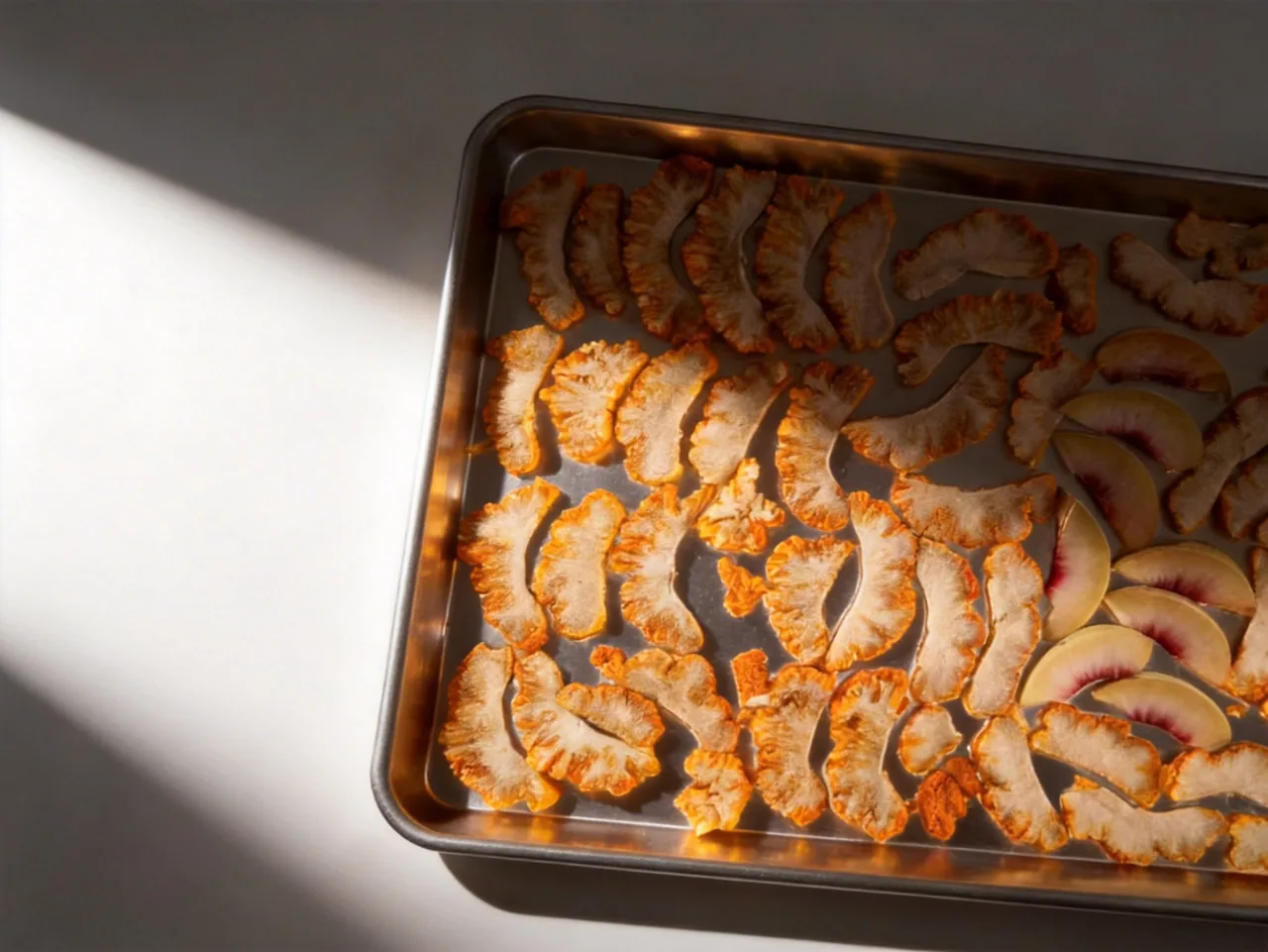
For a shelf-stable dried food, residual moisture is the variable that decides whether the product survives its intended shelf life — no packaging fully saves a batch that missed its target.
- Microbial safety. Microorganisms need available water to grow. Dried foods stay safe at room temperature because that water is missing — aw below 0.60 is the threshold commonly cited in food science for shelf-stable low-moisture foods.
- Texture. Excess remaining water means limp, chewy or soggy pieces where the customer expects crisp. The snap of a freeze dried fruit slice is a direct moisture signal — and the first thing a disappointed customer notices.
- Quality loss in storage. Too-wet product cakes, loses flavor and shifts color faster on the shelf. It can be technically safe yet commercially dead: a texture and taste problem, just as expensive.
Typical target ranges in the literature
No universal number exists — but the literature converges on a familiar band. Treat the numbers below as starting points for your own validation, never as specifications any equipment brand can promise for your product.
- The common band. Published food-science references commonly describe freeze dried foods targeting roughly 1–4% residual moisture.
- The low end. Below about 2% is commonly cited as suppressing most microbial growth — one reason commercial targets cluster near the bottom of the band.
- The risk zone. Above roughly 4–5%, spoilage risk rises significantly: microbial growth, caking and off-flavors become realistic concerns.
- The water-activity threshold. For low-moisture foods generally, water activity below 0.60 is the commonly cited threshold for room-temperature shelf stability. Many producers specify both: a moisture percentage for the process, an aw limit for the finished product.
- What shifts your target. Product type (sugary fruits vs starchy vegetables vs high-fat or high-protein products), intended storage time, and packaging barrier all shift the sensible target.
How producers measure residual moisture
Producers rely on three established approaches, each answering a slightly different question.
- Loss on drying (gravimetric). Weigh a sample, dry it in a laboratory oven, weigh it again; the weight lost is the moisture. Simple, destructive and relatively slow — the classic reference method for routine batch checks.
- Water activity meter. Measures aw by reading the equilibrium relative humidity above the sample. Fast and non-chemical; it answers the shelf-stability question directly, which is why it complements moisture content rather than replacing it.
- Karl Fischer titration. A chemical method in which iodine reacts quantitatively with the water in a sample — the lab reference when precision matters, e.g. validating a new product's target.
- Sampling discipline. Test representative samples from across the tray stack and chamber, not one corner of one tray. Moisture varies by position; a single reading can lie.
What pushes final moisture up or down
When a batch lands off target, the cause is usually on a short list of process variables — all of them controllable.
- Loading thickness and tray density. Thicker layers and tightly packed pieces slow vapor escape; the center of a thick load is always the last to dry.
- Primary and secondary drying settings. The time–temperature–vacuum program decides how completely each stage finishes. Cutting secondary drying short is the most common way to land high.
- Cold trap performance. The trap must capture the vapor load the product releases. A trap that falls behind lets chamber pressure rise and drying stall.
- Ambient humidity at discharge. A well-dried batch can pick up measurable moisture within minutes in humid factory air. The target can be lost after the dryer, not in it.
- Product characteristics. Sugars, salts and fats bind water differently, so the same program lands at different moisture on different products. New products need their own validation.
Over-dried vs under-dried: the trade-off
Moisture targets are a balance: both directions carry costs, and the optimum is the validated target — rarely the absolute minimum.
- Under-dried — the common failure. Moisture above target means softer texture, clumping or caking, faster quality loss, and at the high end real microbial risk. This is the direction that creates recalls and rework.
- Over-dried — the quiet cost. Drying past the target wastes energy and cycle time, and can leave pieces excessively fragile — shattering into powder in the pack. Once in the low band, further drying buys no meaningful extra safety.
- The rehydration test. Product dried to its validated target rehydrates evenly; off-target moisture shows up as patchy rehydration. Rehydration trials are a practical, low-cost way to confirm a target.
Packing and storage: locking the target in
Hitting the target in the dryer is only half the job. Freeze dried foods are hygroscopic — everything after discharge either protects the number or destroys it.
- Pack immediately. Minimize the time between discharge and sealing. Product should move from tray to sealed pack as one flow, not wait in open bins.
- Moisture-barrier packaging. Foil-laminate pouches or sealed rigid packs matched to the intended shelf life. Thin commodity film will not hold a 2% target for a year.
- Low-humidity packing environment. A dehumidified packing room adjacent to the dryer discharge, so the product never travels through humid factory air.
- Storage reality. Warehouse humidity and temperature still matter after sealing. Validate shelf life at your actual storage conditions — the target has to hold in your customer's warehouse too.
Specifying moisture targets with your equipment supplier
A moisture target only works if the dryer can hold the process that delivers it. Put it in writing with the supplier — as the control capability you are buying.
- Write the target into the process specification. State your residual-moisture and water-activity targets as acceptance criteria for commissioning trials on your actual product.
- Demand recipe control. The dryer should store the validated drying curve per product — on QS machines, the Siemens S7-200 PLC with touchscreen stores full recipes selectable by product name.
- Fine temperature control. Four-zone independent heating control (±0.1 °C, max 80 °C) holds the product at the highest safe temperature through secondary drying — the stage that decides final moisture.
- Batch records and monitoring. Temperature and vacuum logging per batch, so a moisture deviation traces back to the cycle that produced it.
- Commercial terms. QS freeze dryers carry a 1-year warranty with roughly a 3-month lead time — schedule validation trials against the same clock as the rest of the line.
Frequently asked questions
What is a good moisture target for freeze dried fruit?
Food-science references commonly cite roughly 1–4% residual moisture for freeze dried foods, with fruit often near the low end — sugars hold water and excess moisture causes stickiness. Validate the exact target on your own fruit, trays and recipe, and pair it with a water-activity check below 0.60.
How is residual moisture measured?
Three standard approaches: loss on drying — weigh, oven-dry and reweigh a sample, the classic reference method; a water activity meter, which reads available water (aw) quickly and answers the shelf-stability question; and Karl Fischer titration, the chemical lab reference when precision matters. Sample across the tray stack — moisture varies by position.
What happens if moisture is too high?
Texture suffers first — limp pieces where crisp was expected — then caking, faster flavor loss, and above roughly 4–5%, significantly rising spoilage risk. It usually traces to a short secondary-drying stage or humid handling after discharge.
Can you over-dry a product?
Yes — economically and texturally. Drying past the validated target wastes energy and cycle time and can leave pieces fragile enough to shatter in the pack. Once in the low band, further drying buys no meaningful extra safety.
Does target moisture differ by product?
Yes. Sugary fruits, starchy vegetables, and high-fat or high-protein products bind and release water differently, so one drying program lands at different moisture on different materials. Storage time and packaging barrier shift the target too. Literature ranges are starting points — validate per product.
Validating a moisture target for your product?
Send us your product specs and target output — we'll map the drying process and size the right freeze dryer. See the range on our freeze dryer page.
Specifications are for reference only and are subject to the final supplied equipment.