
Home / Insights / What Does Freeze Drying Really Cost?
PILLAR GUIDE
What Does Freeze Drying Really Cost?
What freeze drying really costs: machine price, energy, labour and maintenance — with real prices for the QS-FD-100 and the drivers that move total cost.
The machine is only the first cost
Buyers usually ask for the machine price first, and that is fair — but it is only the first of four costs. The full picture is: the machine, the energy to run it, the labour to load and unload it, and the maintenance to keep it running. Judge a freeze dryer on all four, not on the price tag alone.
Machine prices: one concrete example
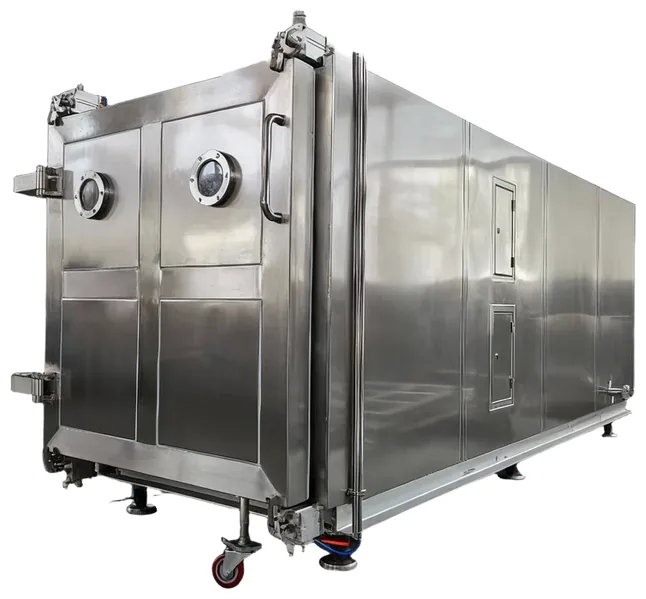
Our QS-FD-100 — 103.68 m² of tray area, 432 trays, 135 kW installed power, about 1 tonne per batch — is priced at USD 238,645 for the standard round chamber and USD 328,135 for the high-spec square chamber. The difference is the upgraded electrical system, the intelligence and automation package, and the upgraded vacuum pump unit. Smaller machines cost less and larger machines cost more — our QS-FD-20 takes about 200 kg per batch and the QS-FD-200 about 2 tonnes — but price a machine against your real batch size, not against a catalogue range. A machine that is twice as big does not cost twice as much, and it does not earn twice as much if your raw material supply cannot fill it.
Energy: installed power is not what you pay
A freeze dryer's brochure lists installed power. What you pay for is actual power draw, and the two are different. The refrigeration compressors cycle on and off through the drying stages, so actual draw is about 60% of installed power in normal operation. On the QS-FD-100, that means the running load is far below the 135 kW nameplate. Two things move energy cost more than the nameplate: how well the cold trap holds −60 °C, and how evenly the four heating zones deliver heat. A machine that cannot hold temperature wastes energy on every batch, and the waste shows up on the electricity bill, not on the quotation.
Labour: loading and unloading is the bottleneck
Freeze drying itself is automatic — the cycle runs on a Siemens S7-200 PLC and the operator monitors it. The labour is in loading trays, unloading trays and packing the dried product. Tray size matters here: our standard tray is 400 × 600 mm, and the QS-FD-20 holds 84 of them while the QS-FD-100 holds 432. A line that loads fast and packs fast earns more per shift than a line that saves a few minutes of cycle time. When you cost labour, count the full handling chain — receiving, washing, cutting, loading, unloading, packing — not just the machine.
Maintenance: the parts that wear
The parts that wear on a freeze dryer are the vacuum pumps, the door seals and the refrigeration system. Our machines use a Roots plus screw vacuum pump combination and food-grade silicone door seals; both are standard industrial parts with a known replacement cost. Ask any supplier for a two-year spare parts list with prices before you order, so maintenance cost is a number on paper instead of a surprise. Our machines carry a 12-month warranty, and installation and commissioning by our engineers is USD 200 per person per day, with travel and accommodation by the buyer.
How to compare quotations fairly
Ask every supplier for the same things: tray area and tray count, cold trap temperature and refrigerant, number of heating zones and their accuracy, vacuum pump type, installed power and expected actual draw, a two-year spare parts list, delivery time, warranty and payment terms. Our terms are 50% deposit and 50% before shipment, delivery in about 3 months, FOB Shanghai. A quotation without a process flow and an equipment list is not comparable with one that has them — it is a different product.
Frequently asked questions
What is the biggest cost driver in freeze drying?
Energy and labour run ahead of the machine price over the life of the line. Actual power draw is about 60% of installed power, and loading and packing dominate labour. Size the machine to real batches and automate handling where you can.
Why does the QS-FD-100 have two prices?
USD 238,645 is the standard round chamber. USD 328,135 is the high-spec square chamber, with upgraded electrical, intelligence and automation, and an upgraded vacuum pump unit. Both dry about 1 tonne per batch; the difference is configuration, not capacity.
How do I know what a machine will really cost me per year?
Get the installed power and the expected actual draw, your local electricity price, the spare parts list with prices, and your labour plan for loading and packing. Those four numbers give you a real annual cost. We provide all four before you order.
Can I test my product before buying?
Yes. We run free sample tests in our factory — you pay shipping only. The sample shows the real dried result for your product, which is what any cost calculation actually depends on.
Does a bigger freeze dryer always cost less per kilogram?
Not if you cannot fill it. A half-loaded chamber uses nearly the same energy as a full one. The cheapest cost per kilogram comes from a machine sized to the raw material you can reliably supply, run full, every batch.
Supporting guides
Deeper reading from our knowledge base on this topic: