Why seasoning comes after de-oiling
Vacuum frying ends with in-chamber centrifugal de-oiling: the basket spins inside the vessel and throws surface oil off the product before the chamber opens. That step is essential for a crisp, light snack, and it dictates where seasoning belongs in the sequence. Seasoning applied before de-oiling is spun off with the oil, or smeared unevenly by it, so the finished snack ends up patchy: some pieces over-seasoned, most under-seasoned, and the seasoning that survives distributed by chance rather than by design.
There is a second reason for the order. Oil left on the surface blocks adhesion. Dry powder needs a dry, slightly textured surface to grip. A surface still filmed with oil lets powder slide and clump instead of coating evenly, and the powder that does stick sits on oil rather than on the product, so it rubs off at the first handling. De-oiling first gives seasoning the surface it needs, and seasoning second keeps the seasoning where it was put. The full de-oiling step is explained in our guide on vacuum frying deoiling.
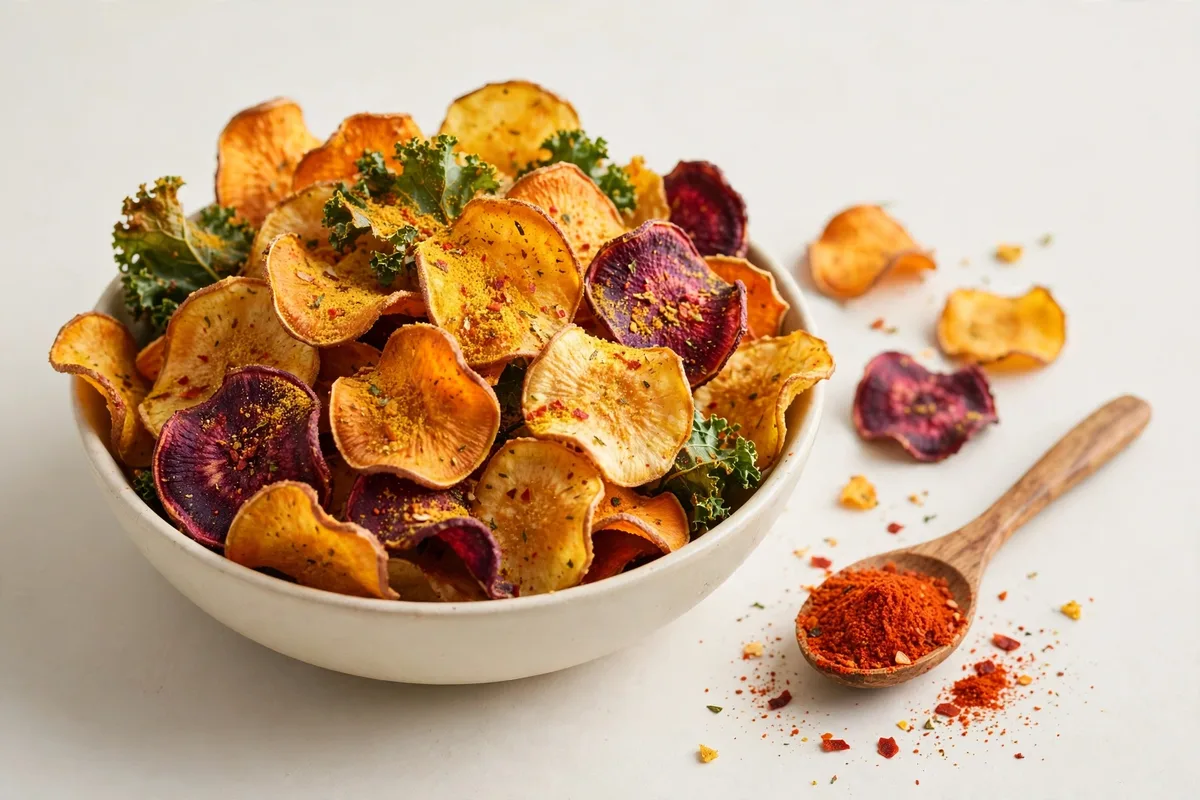
Dry powder versus oil-carried seasoning
Seasoning reaches the snack in one of two carriers, and the choice changes the result.
Dry powder seasoning
Dry powder is the default for most vacuum fried crisps. It is applied by dusting or tumbling after de-oiling, coats evenly when the powder is fine and the pieces are dry, and adds no oil back to a product that was just de-oiled. Its limits are adhesion on very smooth pieces and the dust created during application.
Oil-carried seasoning
Oil-carried seasoning suspends flavour in a small amount of oil, which is then sprayed or tumbled onto the product. It suits flavours that do not distribute well as dry powder, such as some spice pastes, cheese-style coatings, and glaze-type flavours, and it can grip smooth surfaces better than powder. Its risk is greasiness: too much carrier oil undoes the benefit of de-oiling and leaves the snack heavy. Applied lightly, with the carrier treated as a flavour vehicle rather than an ingredient in its own right, it gives an even, well-adhered coating.
Neither carrier is universally better. The test is always the same: evenness of coating, adhesion after handling, and eating quality. Run both carriers on the same product, side by side, and let those three tests decide.
What makes seasoning stick

Adhesion is the difference between a snack that tastes seasoned in the pack and one that tastes seasoned only in the factory. Several factors control it:
- A dry surface. Season after de-oiling, when the surface is as free of oil film as the process allows. Powder on an oily surface sits on the oil, not the product, and leaves with the first touch.
- Piece texture. Rough, porous, or ridged surfaces hold powder far better than smooth, glossy ones. Thin, flat crisps and smooth-coated pieces need finer powder and gentler handling to keep their coating.
- Powder fineness. Fine powder coats more evenly and grips better than coarse powder, which bounces off and collects in the bottom of the tumbler. Grind or sieve seasoning to a consistent fineness before application.
- Even tumbling. Seasoning should be applied while pieces move, so every surface gets its share. Dumping seasoning onto a still pile coats the top pieces heavily and leaves the rest bare.
- Timing. Season soon after de-oiling, while the pieces are still warm from the vessel and their surfaces are most receptive. Pieces seasoned long after cooling, or after sitting in humid air, coat less evenly.
- Gentle handling afterwards. Every transfer, conveyor, and packing step rubs some seasoning off. Design the line so seasoned product moves as little as possible before packing, and check adhesion at the pack, not just at the seasoning station.
Flavour families to consider
Flavour families are starting points for trials, not prescriptions. Each one behaves differently on a crisp base, and the notes below cover the ranges most vacuum fried snacks fall into.
- Savoury. Sea salt, salt and vinegar style, cheese-style, sour cream and herb style, and roasted garlic style seasonings. These are the broadest family and the safest starting point for a new product, because they complement rather than compete with the product flavour.
- Spicy. Chilli, chilli lime, black pepper, and warm spice blends. Heat should be judged on the finished snack, not on the raw seasoning: frying and de-oiling change how heat is perceived, and trial tasting is the only reliable guide.
- Sweet. Honey glaze style, cinnamon sugar style, caramel style, and lightly sweetened fruit crisps. Sweet coatings need care with stickiness and with clumping during storage, and they suit products whose own flavour is already sweet.
- Regional. Seaweed, curry, barbecue-style, tom yum style, and other regional profiles. These can differentiate a product strongly in a specific market, but they should be developed with tasters from that market, because regional expectations for salt, heat, and sweetness differ.
Whatever the family, the product flavour underneath still matters. Vacuum frying at 80–100°C preserves delicate product flavour well, so the seasoning should frame that flavour rather than bury it. A seasoning that overwhelms the product wastes the main advantage of the process.
A trial-batch method for a new flavour
Developing a flavour by guessing on full batches wastes product and teaches little. A trial-batch method is slower per variant and far faster to a good result:
- Establish the unseasoned baseline. Fry and de-oil a batch with no seasoning, and taste it. The baseline tells you what the seasoning must add and what it must not hide.
- Vary one thing at a time. Change the flavour family first, keeping carrier and application fixed. Once a family wins, vary the carrier, then the application method. Changing everything at once leaves no way to tell what worked.
- Keep trial batches small but realistic. Small enough for several variants in a session, large enough to tumble and pack like a real batch.
- Taste blind where possible. Compare variants without labels, against the baseline and against each other. Blind tasting catches small differences and personal bias alike.
- Check adhesion and packing survival. After tasting, handle the winning variant as the line will handle it, pack it, and open the pack later to check the coating survived. A flavour that tastes perfect but falls off in the pack is not finished.
- Record the winner qualitatively. Note the flavour family, the carrier, the application method, and what the tasters said. The record lets the next batch repeat the result and lets the next flavour start from knowledge rather than from scratch.
Seasoning and packing

Seasoning continues to matter after the snack leaves the seasoning station. Some seasonings attract moisture from the air, which softens crisps and clumps powder, so seasoned snacks should move promptly into sealed packing and be kept dry during handling.
Storage behaviour deserves a place in the trial too. A flavour that tastes right on the day of production but loses its edge during storage has not passed the trial, so check trial packs after storage, under the conditions the product will actually face, before scaling up.
Common seasoning mistakes
- Seasoning before de-oiling. The most common error, and the most expensive in wasted seasoning and uneven product.
- Seasoning onto an oily surface. Powder that sits on oil instead of product rubs off at the first handling.
- Coarse or inconsistent powder. Uneven particle size gives uneven coating, with fine dust on some pieces and bare patches on others.
- Seasoning a still pile. Without movement during application, the top of the pile takes everything and the rest takes nothing.
- Judging adhesion too early. Coating checked only at the seasoning station looks better than coating checked after conveying and packing. Judge it at the pack.
- Scaling up an untested flavour. A flavour that was never trialled on small batches, tasted blind, and checked after storage is a gamble at full-batch scale.
Good seasoning is quiet work: the right order, a dry surface, fine powder or a light carrier, even tumbling, and a trial record behind every flavour. Done that way, the snack simply tastes finished, piece after piece, pack after pack.
Frequently asked questions
Why does my seasoning fall off the snack?
The usual causes are seasoning applied before de-oiling, a surface still filmed with oil, or powder too coarse for the piece. De-oiling strips seasoning applied too early, and oil on the surface blocks powder from gripping. Season after de-oiling, on a dry surface, with a fine, even powder, and check adhesion after handling and packing, not just straight after seasoning.
Can I season snacks before vacuum frying?
As a rule, no. Seasoning applied before frying is exposed to hot oil, vacuum, and then in-chamber centrifugal de-oiling, which strips much of it away and leaves an uneven result. The reliable sequence is fry, de-oil inside the chamber, and then season. Any flavour that must survive frying should be tested on trial batches first, because most seasonings do not survive the sequence intact.
Should I use dry powder or oil-carried seasoning?
Dry powder suits most crisp snacks: it is simple, gives an even dusting, and does not add oil back to a product that was just de-oiled. Oil-carried seasoning suits flavours that need a liquid carrier, such as some spice blends and glazes, but it must be applied lightly so the snack does not turn greasy. Trial both on the same product and judge on adhesion, evenness, and eating quality.
How do I develop a new snack flavour?
Start from an unseasoned baseline, then run small trial batches that vary one thing at a time: the flavour family first, then the carrier, then the application method. Taste each variant, check how evenly it coats and how well it survives handling and packing, and record the variant that wins. Only scale up a flavour that passed all three tests — taste, adhesion, and packing survival — on trial batches.
Plan your vacuum frying line
Tell us your snacks and target output — we will help you size the fryer. Explore the range on our vacuum fryer page.
Specifications are for reference only and are subject to the final supplied equipment.