
Home / Insights / Oil Content in Vacuum-Fried Snacks
PILLAR GUIDE
Oil Content in Vacuum-Fried Snacks
Oil content in vacuum-fried snacks: what keeps it under 18%, and how frying temperature, de-oiling, slicing and oil quality move it.
The number that decides whether a snack sells
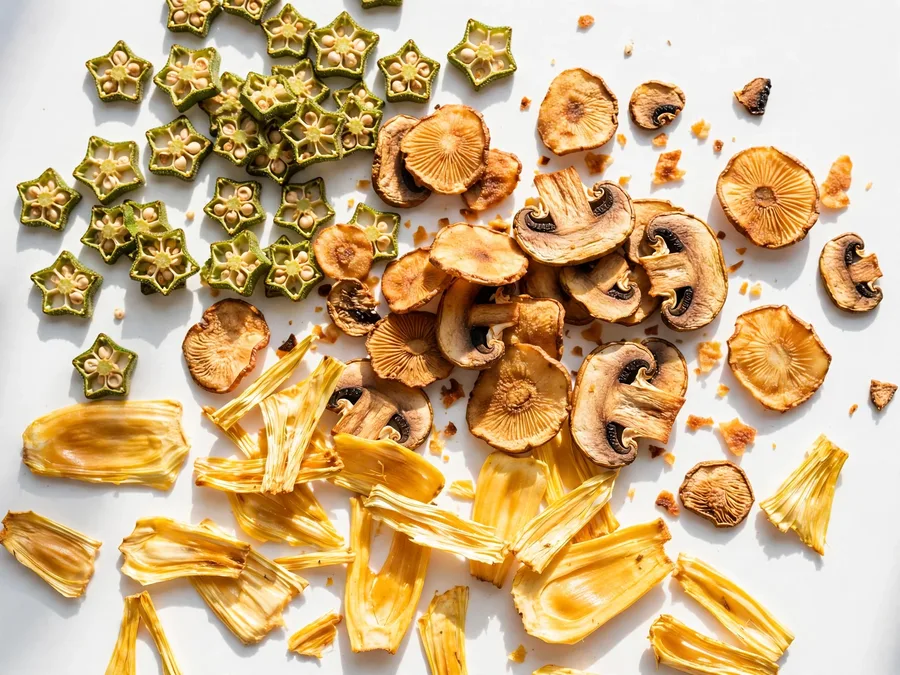
Oil content is the number buyers of vacuum-fried snacks ask about first — their customers read labels, and a chip that tastes greasy does not get a second order. Our vacuum fryers hold finished oil content under 18%. This guide explains what drives that number and how to keep it there.
Why vacuum frying is low-oil by design
Open frying drives oil into food because the food fries at high temperature in air. Vacuum frying works differently in two ways. First, it fries at 80–100 °C, under vacuum, so water leaves the product quickly without the violent bubbling that forces oil in. Second, the product is de-oiled inside the chamber before air returns. Both steps matter; neither alone is enough. A machine that fries under vacuum but opens the chamber with oil still on the product will not reach low oil content, no matter how good its temperature control is.
In-chamber de-oiling is where the number is won
After frying, the basket spins inside the chamber while it is still under vacuum. Centrifugal force throws the oil off the product surface before the chamber opens and air rushes in. Without this step, oil soaks back into the product as pressure returns — the snack absorbs oil at exactly the moment you stop watching. Our machines de-oil in the chamber, centrifugally, and that is the main reason oil content stays under 18%. When you compare fryers, ask this first: is de-oiling in-chamber, is it centrifugal, and what oil content do you guarantee for my product?
What moves oil content up or down
Frying temperature. Inside the 80–100 °C range, the right set point depends on the product. Too low and the product sits in oil longer than it needs to; too high and the surface browns and seals oil in. The machine must hold its set temperature steadily — a vessel that swings in temperature produces batches that swing in oil content.
Slice thickness. Even slicing is not cosmetic. A thick slice fries slower and holds more oil than a thin one from the same batch, and uneven slices mean uneven oil content across the batch. Slicing to even thickness is one of the cheapest ways to control oil content.
Oil quality. Degraded oil — dark, full of food particles, past its life — absorbs into product more readily than fresh oil. Filtration between batches keeps oil usable longer, and our machines extend oil life by +200% compared with unfiltered open frying practice. Fresh, filtered oil is a quality control measure, not just a cost measure.
Product choice. It has to be said honestly: oil content depends on the product. A dense root vegetable and a porous fruit do not finish at the same oil content in the same machine. The under-18% figure is what our machines achieve across the fruit and vegetable snacks they are built for — measure it on your own product with a sample batch before you commit to a number on your label.
Oil content by product: what to expect
It has to be said honestly: oil content depends on the product. A dense root vegetable and a porous fruit do not finish at the same oil content in the same machine. Porous products — fruit with an open structure, mushroom, light vegetables — take up more oil than dense products, because there is more surface and more open space for oil to sit in. Thickness matters the same way: a product sliced thick has a smaller surface-to-weight ratio and fries more slowly, while a thin slice dries out fast and can over-crisp.
That is why the under-18% figure should be read as the range our machines achieve across the fruit and vegetable snacks they are built for, not as a promise for every product on earth. The honest way to quote oil content for your label is to fry your product, test the finished batch, and print the number you measured. A label figure that came from your own product is a figure you can defend; a figure copied from a brochure is not.
Measuring it
Do not accept a supplier's oil content figure without knowing how it was measured. The figure should come from a laboratory test on a finished batch of a stated product, not from a calculation. We fry sample batches of your product in our factory free of charge — you pay shipping only — and you can test the result yourself. That is the only oil content figure that matters for your label.
Frequently asked questions
What oil content do your vacuum fryers achieve?
Under 18% on finished fruit and vegetable snacks, with in-chamber centrifugal de-oiling. The exact figure for your product should be measured on a sample batch.
Why is de-oiling done inside the chamber?
Because oil soaks back into the product the moment air returns. Spinning the oil out while the chamber is still under vacuum removes it before that can happen. De-oiling after the chamber opens is too late.
Does slice thickness really affect oil content?
Yes. Uneven slices fry unevenly, and the thick pieces hold more oil. Even slicing is one of the cheapest quality controls on a frying line.
Does oil quality change oil content?
Yes. Degraded, particle-filled oil absorbs more readily into the product. Filtration between batches keeps oil in condition and keeps oil content stable batch to batch.
Can I verify the oil content before buying?
Yes. We run free sample frying in our factory — you pay shipping only — and you can have the finished product tested independently. That is the figure to put on your label.
Supporting guides
Deeper reading from our knowledge base on this topic: