
Home / Insights / How to Calculate Freeze Dryer and Vacuum Fryer Capacity
PILLAR GUIDE
How to Calculate Freeze Dryer and Vacuum Fryer Capacity
How to calculate freeze dryer and vacuum fryer capacity: tray area, raw material per batch, loading density, and why no single cycle time exists.
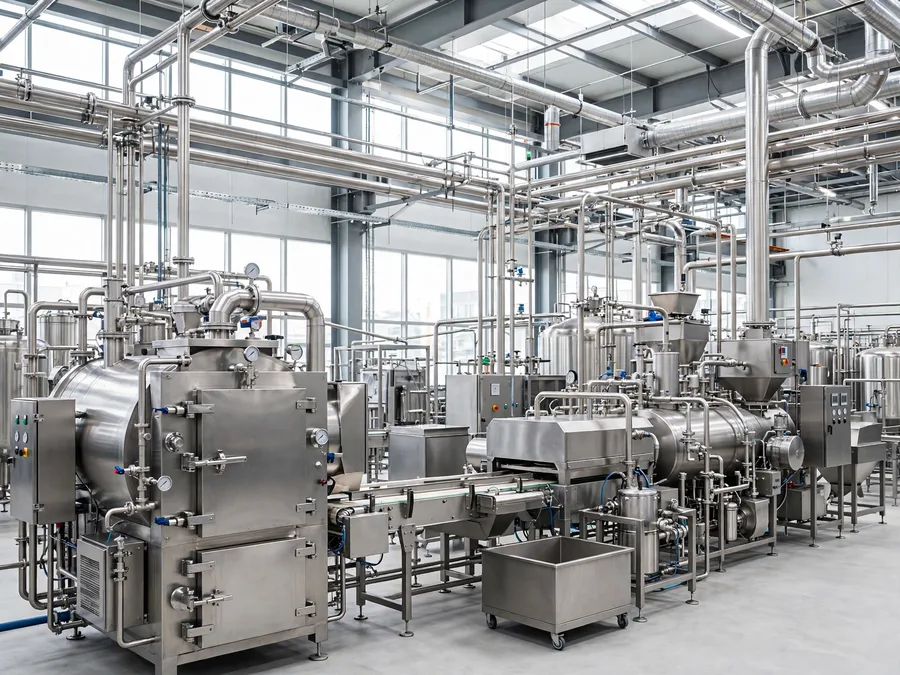
Capacity starts with the batch
Capacity is not one number. It is two numbers: how much goes into one batch, and how many batches you run. Every other figure — per day, per week, per year — is those two multiplied together. If a supplier gives you only one of them, the capacity figure is meaningless.
Freeze dryers: tray area is the sizing metric
A freeze dryer is sized by tray area, because tray area decides how much product fits in one batch. Our range:
| Model | Tray area | Trays | Batch size |
|---|---|---|---|
| QS-FD-20 | 20.16 m² | 84 (400 × 600 mm) | ~200 kg |
| QS-FD-100 | 103.68 m² | 432 | ~1 tonne |
| QS-FD-200 | 207.36 m² | 864 | ~2 tonnes |
Batch size means raw material input. Loading density — how many kilograms sit on each square metre of tray — varies by product. Sliced fruit spreads thin; dense pastes and purees load heavy. Two products with the same tray area can differ in batch weight by a wide margin, and that is normal. The honest way to size a dryer is to test your product: load trays the way you will load them in production, weigh the load, and calculate from that. A supplier who quotes a batch weight without saying which product it applies to is quoting a guess.
Vacuum fryers: raw material per batch
A vacuum fryer is sized by raw material per batch, which is simpler to state:
| Model | Raw material per batch |
|---|---|
| QS-VF100 | 100 kg |
| QS-VF150 | 150 kg |
| QS-300 | 300 kg |
Finished weight is always lower, because frying drives water out. How much lower depends on the product's water content — a water-rich fruit loses more than a dense root vegetable — so finished output cannot be calculated from raw input alone. Cost and capacity planning should be done on raw material input, and finished yield should be measured on a sample batch of your own product.
Why there is no single cycle time
Buyers often ask for the cycle time — how many hours a freeze drying batch takes, how many minutes a frying batch takes. There is no fixed answer, because cycle time depends on the product. On a freeze dryer, it depends on the product's thickness, its water content, how it was frozen, and how it is loaded. On a vacuum fryer, it depends on slice thickness, water content and the set temperature inside the 80–100 °C range. Any fixed cycle time printed in a brochure is a figure for one product under one set of conditions — not for yours.
That is why planning should work backwards from the batch, not from a cycle time. First, find your batch size by testing your product. Then, count the batches you can realistically run: loading, unloading, cleaning between batches, and packing all take time. Throughput is batch size times batches per period. If you need more throughput, the answer is usually more tray area or a larger fryer — or a second machine — not a shorter cycle.
The calculation, step by step
- Test your product. Load trays or the fryer basket the way production will. Weigh the load. That is your batch size.
- Count your batches. Be honest about loading, unloading and cleaning time. A line that runs two full batches a day earns more than a line that is quoted at three and delivers two.
- Multiply. Batch size × batches per period = throughput for that period. Do this per product, because the numbers change with the product.
- Add a growth step. Buy the size that fits your real volume today with one step of growth — for example, from a 200 kg batch to a 1-tonne batch — not three steps. An oversized machine running half-full wastes energy and floor space.
A word on power
Installed power grows with machine size — 35 kW on the QS-FD-20, 135 kW on the QS-FD-100 — but actual power draw in normal operation is about 60% of installed power, because the compressors cycle. On the QS-FD-200, total installed power is confirmed by our engineering team for each order rather than fixed in a brochure. Check your site's power supply against installed power when you plan, and cost energy on actual draw.
Frequently asked questions
Why won't suppliers give me a fixed cycle time?
Because it does not exist. Cycle time depends on the product — its thickness, water content, freezing method and loading. Any fixed number is a figure for one product, not yours. Plan from tested batch size and realistic batches per period instead.
How do I find my real batch size?
Test it. Load the trays or basket the way production will, weigh the load, and record it. We run free sample tests in our factory — you pay shipping only — and the sample gives you a real batch figure for your product.
Is tray area or batch weight the better comparison?
Tray area, for freeze dryers. Batch weight changes with the product; tray area does not. Compare dryers on tray area first, then test your product's loading density on it.
How do I plan for growth?
Size one step above today's volume. A second machine later is easier to justify — and cheaper to run — than one oversized machine running half-full from day one.
What about finished output — how much product do I get per batch?
Less than the raw input, because water leaves the product. How much less depends on the product. Measure finished yield on a sample batch, and plan costs on raw material input.
Supporting guides
Deeper reading from our knowledge base on this topic: