
Home / Insights / Planning a Complete Food Processing Line
PILLAR GUIDE
Planning a Complete Food Processing Line
Planning a complete food processing line: process flow, sizing, layout, utilities, installation and the questions to settle before you order.
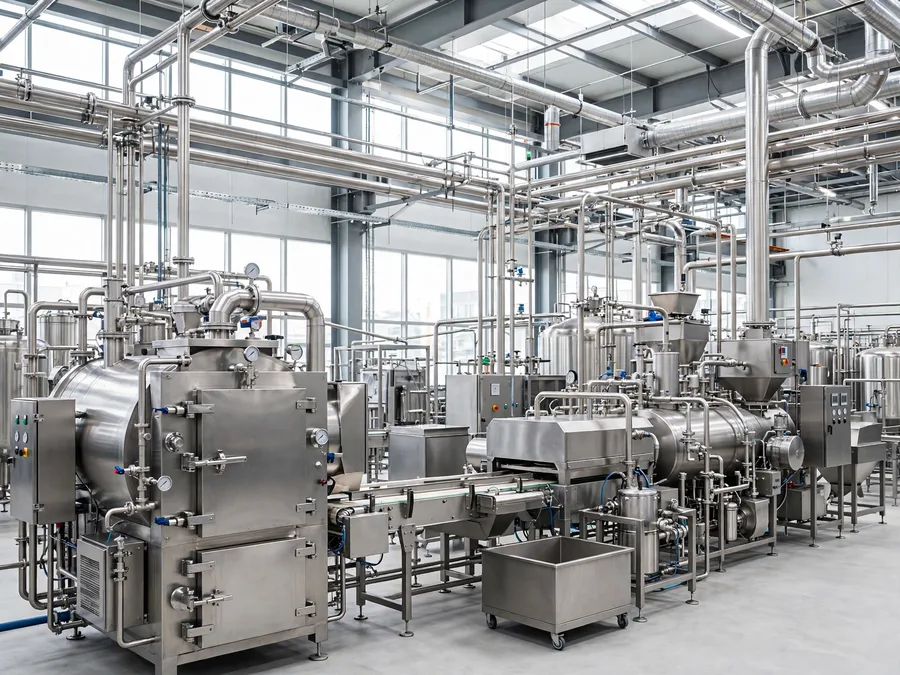
A line is not a collection of machines
A complete processing line is not a set of machines that happen to stand in the same building. It is one process, from raw material in to packed product out, and every machine exists to serve the next step. Planning a line means planning the flow first and choosing machines second. Buyers who choose machines first and then wonder how they connect together pay for that mistake in rework, in extra conveyors, and in batches that stall between steps.
Step 1: define the product and the volume
Write down four things before anything else: what product you make, what raw material it comes from, how much raw material you can reliably supply per day, and what finished output that should give you. Raw material supply is the constraint that governs everything downstream — a line sized for volume you cannot supply is the most expensive machine in the factory. Be honest about seasonality too: fruit lines must be planned for peak-season volume, and the product mix should use what the season offers.
Step 2: the process flow
Draw the flow, step by step, before you talk to any supplier. A typical line reads like this:
Receiving → washing → preparation (peeling, slicing, cutting) → main process (freeze drying or vacuum frying, or both) → post-treatment (seasoning, de-oiling) → packing → storage.
For freeze drying, the main process is: load trays → freeze → dry under vacuum → unload. For vacuum frying: slice → blanch where needed → fry at 80–100 °C under vacuum → de-oil in the chamber → season → pack. Each step needs its own equipment, its own floor space and its own labour. If a supplier's quotation has no process flow diagram, the quotation is not a line — it is a list.
The two items buyers most often find missing after the order is placed are the oil filtration tank on a frying line and the packaging machine. Get both in writing, explicitly, on the equipment list.
Step 3: size each machine to the flow
Size each machine to the step it serves, not to the catalogue. A freeze dryer is sized by tray area — 20.16 m² on the QS-FD-20 (~200 kg per batch), 103.68 m² on the QS-FD-100 (~1 tonne), 207.36 m² on the QS-FD-200 (~2 tonnes) — with batch weight measured on your product, because loading density varies by product. A vacuum fryer is sized by raw material per batch — 100, 150 or 300 kg on the QS-VF100, QS-VF150 and QS-300. Do not plan from a fixed cycle time: cycle time depends on the product, its thickness and its water content, so it cannot be quoted as a single figure for all products. Plan from tested batch size and realistic batches per period.
The machines must also match each other. A preparation line that feeds 500 kg an hour into a dryer that takes 200 kg per batch creates a bottleneck; a packing line that handles half the fryer's output creates a queue. The flow must balance, step by step, or the fastest machine in the line is irrelevant.
Step 4: layout, utilities and space
A line needs more than machine footprints. Allow space for raw material in, finished product out, tray loading and unloading, cleaning between batches, spare parts and a maintenance aisle. Give the installation a main aisle wide enough for a forklift and a pallet. Site preparation covers three things: power, water and space. Check installed power against your supply — 35 kW on the QS-FD-20, 135 kW on the QS-FD-100, and actual draw in normal operation is about 60% of installed power — and confirm water supply and drainage for washing and cleaning. On the QS-FD-200, total installed power is confirmed by our engineering team for each order.
Step 5: installation, commissioning and training
A line is not finished when the machines arrive — it is finished when the first good batch leaves the line. Our engineers install and commission on site at USD 200 per person per day, with travel and accommodation by the buyer; a typical installation takes about five days once power, water and gas are ready, with about two engineers. Training is part of the same visit: the operators who run the line must be trained on it, and the PLC recipes — Siemens S7-200 on the freeze dryers, Delta PLC with MCGS touchscreen on the vacuum fryers — must be set up for your products, not left at factory defaults.
Terms to settle before ordering
Ask for a process flow diagram and a full equipment list, including the filtration tank and the packaging machine. Our terms are: 50% deposit and 50% before shipment, delivery in about 3 months, FOB Shanghai, 12-month warranty. Ask for a two-year spare parts list with prices before ordering. And before you commit to any line, test the product: we run free sample processing in our factory — you pay shipping only — so the first batch proves the line before the line is ordered.
Frequently asked questions
What should I settle first: the machine or the product?
The product. Define it, secure its supply, and test it. A line built around a tested product works; a line built around a machine catalogue does not.
Why do I need a process flow diagram?
Because a line is a flow, not a list. The diagram shows every step, exposes missing equipment — filtration, packaging, conveyors — and lets you check that each machine matches the step before and after it.
What is the most common planning mistake?
Sizing the machines before securing raw material supply. A line that cannot be fed loses money faster than any other mistake.
How long does installation take?
About five days once power, water and gas are ready, with about two engineers from our side. That includes commissioning and operator training. The exact time depends on the size of the line.
Can I test the line before buying it?
You can test the product that decides whether the line works. We process sample batches in our factory free of charge — you pay shipping only — and the result is the evidence the line is built on.
Supporting guides
Deeper reading from our knowledge base on this topic:
- Exporting Food Equipment: Buyer Essentials
- Factory Acceptance Test for Food Machinery
- Freeze Dried Food Export Guide
- Freeze Dried Food Packaging Guide
- How to Vet a Food Machinery Manufacturer
- Request a Quote: Industrial Food Machinery
- Start a Freeze-Dried Food Business
- Starting a Vacuum Fried Snacks Business
- Vacuum Fried Snacks Export Packing Guide
- Vacuum Fried Snacks Private Label Guide