
Home / Insights / Fruit and Vegetable Snack Lines
PILLAR GUIDE
Fruit and Vegetable Snack Lines
Fruit and vegetable snack lines: freeze-dried and vacuum-fried products, process steps, batch sizes and how to choose the line for your fruit.
One market, two technologies
Fruit and vegetable snacks are one market with two technologies inside it. Freeze drying makes light, crisp pieces that keep the shape and colour of the fresh fruit. Vacuum frying makes chips and crisps with a bite. Both sell. The line you build depends on the product you want on the shelf, not on the machine you happen to like.
The two product families
Freeze-dried snacks. Fruit pieces, vegetable pieces, mixed fruit and vegetable blends. The product keeps its shape, looks like the fresh fruit, and rehydrates quickly. Our freeze dryers cover the range: QS-FD-20 at about 200 kg per batch (20.16 m², 84 trays), QS-FD-100 at about 1 tonne (103.68 m², 432 trays) and QS-FD-200 at about 2 tonnes (207.36 m², 864 trays). The cold trap holds −60 °C, heating runs in four zones to ±0.1 °C, and a Siemens S7-200 PLC repeats each cycle.
Vacuum-fried snacks. Fruit chips, vegetable crisps, root-vegetable chips, mushroom crisps. The product fries at 80–100 °C under vacuum and is de-oiled inside the chamber, finishing with oil content under 18%. Our fryers take 100, 150 and 300 kg of raw material per batch on the QS-VF100, QS-VF150 and QS-300.
The process, step by step
Both lines start the same way: receiving, washing, peeling where needed, and slicing. From there they diverge.
Freeze drying line: slice or dice → load trays → freeze → dry under vacuum → unload → pack. The quality steps are even loading, the cold trap holding −60 °C, and even heating across the four zones. Loading density varies by product, so batch weight should be measured on your fruit, not taken from a brochure.
Vacuum frying line: slice → blanch where the product needs it → fry under vacuum at 80–100 °C → de-oil in the chamber → season → pack. The quality steps are even slicing, steady frying temperature, in-chamber centrifugal de-oiling, and seasoning applied while the product is still warm.
Preparation is where the labour sits on both lines: washing, peeling, slicing and loading. When you cost labour, count the whole chain, not just the machine.
Fruit-by-fruit notes
Berries and soft fruit (strawberry, blueberry, raspberry) fit freeze drying best. They are delicate, they lose shape easily, and their value is in looking like the fresh fruit. Vacuum frying is possible for some firm berries, but the premium product is freeze-dried.
Firm fruit (apple, mango, banana, jackfruit) fits both. Freeze-dried mango is a premium product; vacuum-fried banana and jackfruit chips are everyday snacks at a lower price. Mango is the classic product to test both ways: freeze dry one batch and vacuum fry one batch, and compare the price each earns.
Root vegetables (sweet potato, taro, carrot, beetroot) fit vacuum frying best. They are dense, they slice evenly, and they fry into a crisp chip at low oil content. Freeze drying is possible but usually earns less for these products.
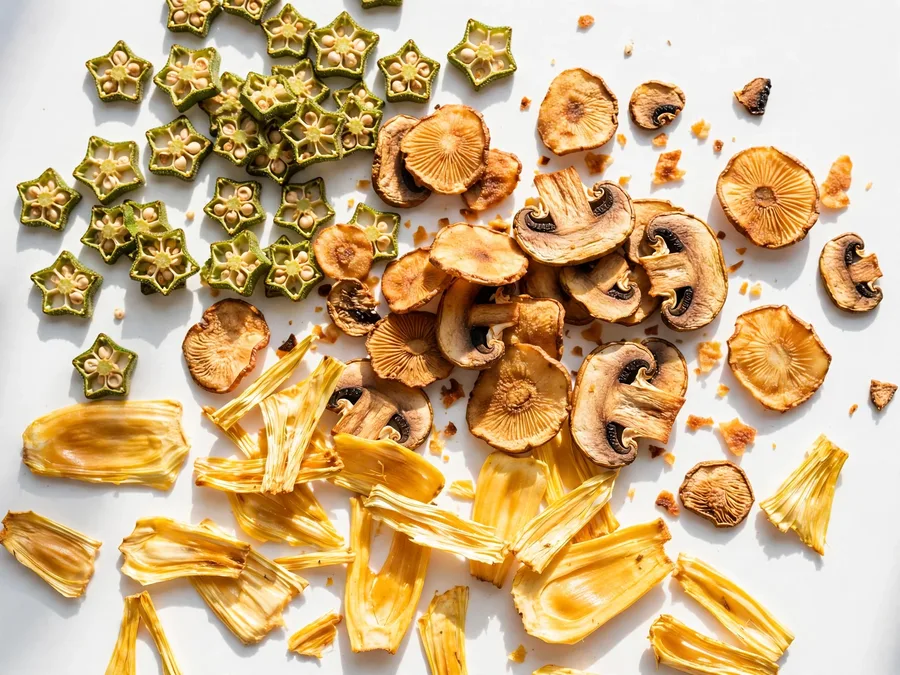
Mushrooms and vegetables (okra, mushroom, green beans, mixed vegetables) fit both, depending on the product. Vacuum-fried okra and mushroom crisps are established snacks; freeze-dried vegetables suit instant foods and soups, where rehydration matters.
Sizing the line
Size by the raw material you can reliably supply. For a fryer, that is raw material per batch — 100, 150 or 300 kg. For a dryer, it is tray area — 20.16, 103.68 or 207.36 m² — with batch weight measured on your product. Do not plan capacity from a fixed cycle time: cycle time depends on the product, its thickness and its water content, so it cannot be quoted as a single figure for all products. Plan from tested batch size and realistic batches per period.
Seasonality is the real planning problem for fruit lines. Fruit comes in season, so the line should be sized for peak-season volume and the product mix should use what the season offers — a fruit calendar for sourcing is part of the business plan, not an afterthought.
Buying questions
Ask for a process flow diagram and a full equipment list. Confirm whether the oil filtration tank and the packaging machine are included — the two items buyers most often find missing after the order is placed. Confirm delivery time (about 3 months), warranty (12 months), payment (50% deposit, 50% before shipment) and installation terms (our engineers at USD 200 per person per day, travel and accommodation by the buyer).
Test before you buy. We run free sample tests in our factory — freeze drying and vacuum frying — you pay shipping only. Put both products on the table and let the market decide.
Frequently asked questions
Which technology should I start with for fruit snacks?
Start with the product your market buys. Premium dried fruit pieces fit freeze drying; everyday chips and crisps fit vacuum frying. If you are unsure, test the same fruit both ways.
Why does cycle time vary by product?
Because it depends on the product's thickness, water content and loading. No fixed cycle time exists for a freeze dryer or a vacuum fryer — plan from tested batch size instead.
What is the most common mistake in snack line planning?
Sizing the machine before securing the raw material. A line that cannot be fed is the most expensive machine in the factory. Secure supply first, then size the machine to it.
How do I keep oil content low on a frying line?
Fry at a steady temperature inside 80–100 °C, slice evenly, filter the oil between batches, and de-oil inside the chamber, centrifugally. Our machines hold oil content under 18% across their fruit and vegetable range.
Can I run both technologies on one site?
Yes. Preparation, packing and distribution are shared, and a mixed line — one dryer, one fryer — is a normal project for us. Start with the technology that fits your first product and add the second when volume justifies it.
Supporting guides
Deeper reading from our knowledge base on this topic:
- Blanching Before Vacuum Frying Guide
- Coated vs Uncoated: Which Frying Fits?
- Freeze Dried Berries Guide
- Freeze Dried Durian: Why It Needs Industrial Equipment
- Mapping a Freeze Dried Snack Line
- Freeze Drying Mushrooms Guide
- Freeze Dried Vegetables for Instant Foods
- Indonesia Fruit Crisp Production Guide
- Vacuum Fried Banana & Jackfruit Chips Guide
- Vacuum Fried Fruit Chips Guide
- Vacuum Fried Legume Snacks Guide
- Vacuum Fried Meat Snacks Guide
- Vacuum Fried Mushroom Crisps Guide
- Vacuum Fried Nuts and Seeds Guide
- Vacuum Fried Seafood Snacks Guide
- Vacuum Fried Snacks Crispness Control
- Vacuum Fried Snacks Seasoning Guide
- Vacuum Fried Snacks Shelf Life Guide
- Fruit Calendar for Vacuum Frying
- Vacuum Frying Root Vegetables: Chips Guide
- Vacuum Frying Slicing Thickness Guide
- Vacuum Fried Sweet Potato & Taro Chips
- What Snacks Can Be Vacuum Fried?