
Home / Insights / How to Choose an Industrial Freeze Dryer
PILLAR GUIDE
How to Choose an Industrial Freeze Dryer
How to choose an industrial freeze dryer: tray area, batch size, cold trap, heating control and what each spec means for your product.
Start with your product, not the machine
Freeze drying is not one process. A tray of sliced strawberries, a tray of yogurt bites and a tray of ready-meal portions behave differently in the same chamber. Before comparing machines, write down three things: what you dry, how much raw material each batch holds, and what the finished product must look and feel like. The answers decide the chamber size, the tray area and the heating control you need. A machine picked on price alone usually costs more later, in rejected batches and rework.
Tray area is the real size of a freeze dryer
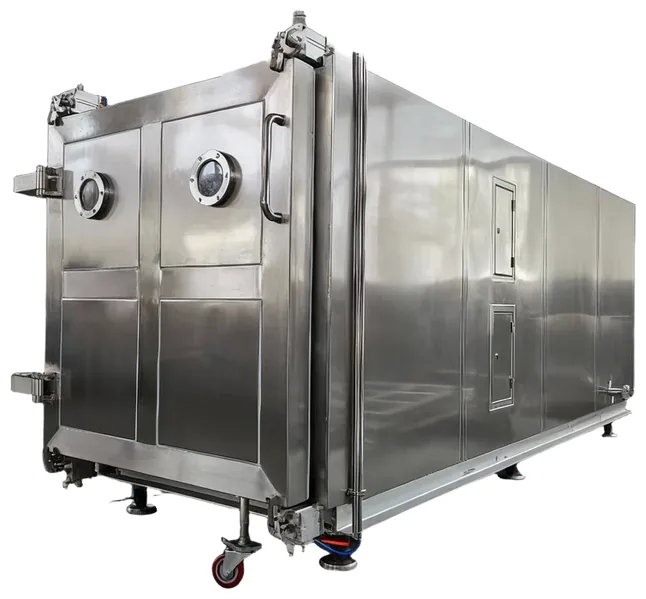
Manufacturers size freeze dryers by tray area, and that is the number that matters. Tray area decides how much product fits in one batch. Our own range shows the scale:
| Model | Tray area | Trays | Batch size |
|---|---|---|---|
| QS-FD-20 | 20.16 m² | 84 (400 × 600 mm) | ~200 kg |
| QS-FD-100 | 103.68 m² | 432 | ~1 tonne |
| QS-FD-200 | 207.36 m² | 864 | ~2 tonnes |
Batch size here means raw material input, and it varies with the product. A light, bulky product fills trays fast at low weight; a dense product does the opposite. Never judge a dryer by a single "kg per batch" figure without knowing which product it was measured on. Ask the supplier what tray area you are buying, how many trays that means, and what loading density they assumed for your product.
The cold trap decides whether drying finishes properly
The cold trap catches the water vapour leaving your product. If it cannot hold temperature, vapour pressure rises in the chamber and drying stalls. Look for a cold trap rated at −60 °C with a two-stage refrigeration system. Our machines use a two-stage R404A/R507 system, and that depth of cold is what keeps a large batch drying evenly to the end. A shallow cold trap is the most common cause of batches that come out damp in the middle.
Heating control decides product quality
Freeze drying removes water by sublimation, and the product must stay frozen while heat is applied. That takes controlled, even heating. Four independently controlled heating zones, accurate to ±0.1 °C and up to a maximum of 80 °C, let you run a different curve for each stage of the cycle. A single heating circuit cannot do that: the trays near the heater overheat while the trays at the far end lag. Ask how many heating zones a machine has and how precisely each one holds its set temperature.
Vacuum system and build quality
The vacuum system has to hold deep vacuum for the whole cycle without drifting. A combination of Roots and screw vacuum pumps, running quietly, is the standard for industrial machines. The chamber should be SUS304 stainless steel, with food-grade silicone door seals — these are the parts that touch your product and the parts that fail first on cheap machines. A Siemens S7-200 PLC with a touchscreen in Chinese and English gives you a repeatable, logged process; if the machine only offers manual valves and gauges, every batch depends on the operator on shift.
Power: ask for actual draw, not just installed power
A freeze dryer lists an installed power — 35 kW on our QS-FD-20, 135 kW on the QS-FD-100 — but installed power is not what you pay for. The refrigeration compressors cycle on and off, so actual power draw is about 60% of installed power in normal operation. Ask any supplier for both numbers, and check the total for the largest model. On the QS-FD-200, for example, total installed power is confirmed by our engineering team for each order rather than fixed in a brochure, because the configuration varies.
Buying questions that protect you
Ask for a process flow and an equipment list, not just a one-page quotation. Ask for a sample test: we source fruit locally, process a sample in our factory, and send it to you — you pay shipping only. A sample answers the questions no brochure can: how your product looks after drying, how it rehydrates, and whether the texture is what your market expects. Confirm delivery time (about 3 months for our machines), warranty (12 months), payment (50% deposit, 50% before shipment) and what installation includes (our engineers install and commission on site; installation is USD 200 per person per day, with travel and accommodation by the buyer).
Frequently asked questions
Should I buy the biggest freeze dryer I can afford?
No. An oversized dryer with a half-loaded chamber wastes energy and floor space. Size the tray area to your real batch, with room to grow one step — for example, from a 200 kg batch to a 1-tonne batch — not three steps.
Is one large dryer better than two smaller ones?
It depends on your product mix. Two smaller dryers let you run two different products at once and keep running if one is down for maintenance. One large dryer is simpler to operate. Decide on your production plan, not on price per square metre.
What does the cold trap temperature tell me?
It tells you whether the machine can hold deep vacuum at the end of a batch. A −60 °C trap with two-stage refrigeration is the industrial standard. Ask what refrigerant the system uses and how the trap is defrosted between batches.
Do I need a PLC, or is manual control enough?
For industrial production, a PLC is not optional. It repeats the same curve every batch, logs what happened, and lets an operator be trained in days rather than months. Our machines run a Siemens S7-200 PLC with a touchscreen in Chinese and English.
Can I test my product before buying?
Yes. We run free sample tests in our factory — you send the material or we source it locally, we freeze dry it, and you pay only the shipping. Test before you commit to a machine.
Supporting guides
Deeper reading from our knowledge base on this topic:
- Fix Common Freeze Dryer Problems
- Confirm Freeze Drying Cycle Complete
- Food Safety for Freeze Dried Products
- Freeze Dried Baby Food Guide
- Freeze Dried Candy Guide
- Freeze Dried Dairy Guide
- Freeze Dried Eggs: A Manufacturer's Guide
- Freeze Dried Food Powders: Milling Guide
- Freeze Dried Food Shelf Life Guide
- Freeze Dried Meat Guide
- Freeze Dried Ready Meals Guide
- Freeze Dried Seafood Guide
- Freeze Dryer Buying Mistakes
- Freeze Dryer Cleaning & Sanitation Guide
- Freeze Dryer Cold Trap Guide
- Freeze Dryer Defrosting Guide
- Freeze Dryer Site Prep: Power, Water, Space
- Freeze Dryer Installation Requirements
- Freeze Dryer Maintenance Checklist
- Freeze Dryer Vacuum Pump Maintenance
- Freeze Dryer Vacuum System Basics
- Freeze Drying Herbs & Edible Flowers Guide
- Freeze Drying Rehydration Guide
- Freeze Drying Yogurt Bites: Process Guide
- Freeze Drying Glossary: Key Terms Explained
- How Industrial Freeze Dryers Work
- How to Read an Industrial Freeze Dryer Spec Sheet
- Freeze Dryer FAQ: Buying & Using Guide
- Why PLC Control Matters in Freeze Drying
- Prefreezing Methods for Freeze Drying
- QS-FD-20 vs 100 vs 200: Which Size Fits You?
- Moisture Content in Freeze Dried Foods
- What Foods Can Be Freeze-Dried?